Thursday, July 19, 2007

What happened yesterday?


it was my turn to stay late. i hadn't eaten any lunch. i knew they'd buy dinner if i stayed after 7pm and it was already well after 5:30pm so i wasn't going to sweat it. sushi, i remember thinking. we should order from yama. i've had their salmon sashimi and it was really quite good. everyone was drifting into evening work mode. all quiet on the midtown east side front.

suddenly, there was a beep and then one of those distorted, abrubt, way too loud what-in-the-world-did-he-just-say announcements by the building management to stay inside. and then someone said excitedly, look out the window. and there was a horde of people out in the middle of the street, moving uptown en masse like well-dressed bison, on lexington avenue. some people were just standing there. some people were moving fast. there were businessmen in filthy expensive suits directing emergency vehicles through the confusion. women in office-to-evening outfits were kicking off their high heels and -- not running -- sprinting. there was fear in the street. you could feel it.

everyone had their cellphones out. everyone was taking pictures. everyone was making little movies.

except me, of course. i didn't charge my photo/video capable palm last night so my battery was dead. no matter. no one else could use their cell phones, either. someone was crying softly at the other end of the hall. i heard this white girl copywriter speak up like a sister and say, loud: i'm not going to die for this job! that's when i remembered: didn't they tell everyone that they could go back into the second tower on 9/11? i thought, who says we're safe in here? what do they know?

why were there people just standing there in the middle of the street?


(this was in front of the public library on fifth -- a few avenue blocks away, but still...!)


pandemonium everywhere. crazy. everyone was looking down lexington avenue at something that we couldn't see because we were looking onto the street. even the people who were running were looking over their shoulders in a freak-out panic, the way they do in horror movies, to see if the monster was gaining on them. wrong angle, to be sure -- but we caught all their reactions. and some people got really scared. i don't think i was scared. but it did freak me out.

stephen stood next to me and blurted, "it looks like invasion of the body snatchers!"

everyone jumped on the internet for information. someone scrambled to make their transistor radio work. i was glad that i had flat shoes on, so i could walk the 100 or so blocks to my place in west harlem. at least i didn't live in new jersey or long island. i'd need a boat to take me home.

all of a sudden, it felt like 9/11 all over again. it certainly looked like it.


it was a transistor explosion at lexington and 43rd. it spewed fire, asphalt, bricks, raw sewage, water and filth so high into the air, and it just kept going and going, the smoke kept rolling, the brown murky water flowing down the street, the asbestos filling the air like yankee smog, the billowing, rolling, stench. and everyone in the street, standing there, taking pictures and making movies.


i didn't stick around for act two. my coworker (the one who said she wasn't going to die for her job) and i walked west, then all the way up past lincoln center to fairway, where we got some comfort food and took the bus home from riverside drive.

somewhere along the way, i asked her if she'd ever been on a farm and she said yes. i said, you know how if you don't drive farm animals into the barn, they won't go -- even if it's raining hard? they'll just stand there in the muck and get soaked. that's what these people looked like. human cows, just standing there. she couldn't stop laughing at that one.

i couldn't laugh. i was wired, i was starving and i was way too relieved that i wasn't a cow.

Friday, July 13, 2007

La Baker!

i can't believe that i know any black dancers that haven't seen josephine baker do her thing. watching her perform "the banana dance" changed my life. her work still has the power to make everyone in the room stop what they're doing and look at her, even if it's only via a grainy sepia-toned video. and no -- i've never heard any neo-burlesque performers mention her, except in passing.

actually, i've never seen any black neo-burlesque dancers perform. hm.

this has no sound, and it's fairly grainy but she's absolutely radiant. be sure to watch the facial expressions of the people sitting around her. that alone is worth the price of admission.

Thursday, July 12, 2007

"The Landlord" out-takes

from the work they had to put in chasing pearl and getting her to say her lines, it's a miracle that they made the short film at all. and yes, it's as funny as the finished product.

The Landlord Out Takes

Wednesday, July 11, 2007

Little Tree, Big Fraud

While scouring the web for information on the KKK (don't ask), I came across this fascinating article: a white professional racist and Klansman reinvents himself as a Cherokee wiseman and novelist, pens the novel that becomes the movie "The Rebel Outlaw Josie Wales" and writes a beloved children's classic "The Education of Little Tree: A True Story." It took a well-researched New York Times article to finally smoke him out.

This would make a great movie. (Tommy Lee Jones could star in it. Or maybe Johnny Dep. Actually, they're both part Cherokee and they're both from the South. Hm.)

Well. I'm not so sure about that title "beloved children's classic," actually. My mother wouldn't let me read it. I didn't understand why then but I do now: it's racist claptrap with fascist overtones, stuffed with sketchy wierd stereotypes -- and bizarrely enough, the book doesn't really teach the reader anything about Cherokee culture. But that's not surprising since Mr. Carter wasn't really Cherokee, anyway.

Then again, my mother didn't let me read Little Black Sambo, either. And we couldn't watch Spanky and Our Gang. The list goes on.

This book has been a mainstay in elementary schools across the country for the past 20 years.

Asa
The two faces of Carter. Asa "Ace" Carter, a founder of the Ku Klux Klan of the Confederacy, in Jefferson County Jail, Alabama, after being charged with attempted murder. Inset, the photo of "Forrest" Carter that appears on the first edition of his bestselling "autobiographical" work, "The Education of Little Tree."


The education of Little Fraud
How did a racist speechwriter for George Wallace turn into a "Cherokee" sage and author of a revered multicultural text? The weird tale of Asa ("Forrest") Carter.

- - - - - - - - - - - -
By Allen Barra

Dec. 20, 2001 Twenty-three years ago this past June 7, Forrest Carter was laid to rest in the Carter family plot at D'Armanville Cemetery near Anniston, Ala. A short time later, family members yanked out the old headstone and put in a new one inscribed with the words "Asa Earl Carter, Sept. 4 1925-June 7 1979."

Forrest must have been spinning in his grave. For the last few years of his life, he tried hard to kill off Asa. And if he had stayed off television, he might have pulled it off.

Forrest Carter was the bestselling author of "The Education of Little Tree: A True Story," a literary phenomenon that was published 25 years ago this fall and is credited by many as the book that touched off the boom in what is still referred to in publishing as "Native American Lit." Carter also wrote another famous book, "The Rebel Outlaw Josey Wales," whose eponymous ex-Confederate superhero was played by Clint Eastwood in the most influential western since "The Searchers."

But "Forrest Carter's" most memorable creation was himself. "Forrest Carter," revered author of the beloved "Little Tree," was actually Asa Carter -- virulent segregationist, former Klansman, speechwriter for George Wallace and professional racist. In both incarnations, Carter is the focus of new interest. Diane McWhorter's critically acclaimed history of the civil rights struggle in Birmingham, Ala., "Carry Me Home," has revealed more about the role of "Ace" as a warrior for white supremacy, while the 25th anniversary publication of Forrest's "The Education Of Little Tree" -- minus the "True Story" subtitle -- continues to exalt him as a pillar of New Age wisdom and a multicultural hero.

For a man with just three slim volumes published in his own lifetime, Forrest Carter made a significant impact on American culture. (A fourth book, "Cry Geronimo," published posthumously, has influenced two screen depictions of the Apache chief.) "The Education of Little Tree," about an orphan boy named Forrest who learns about life from his sage Cherokee grandparents, has never been out of print since it was first published in 1976 to rave reviews in the New York Times, the Atlantic Monthly and elsewhere. According to an editor at the now-defunct Delacorte Press, the book sold more than a million copies in hard and soft covers before the University of New Mexico Press picked it up in 1985. Since then, it has become the biggest seller in the publisher's history and one of the great publishing successes for any university press, selling more than 1,440,000 copies in paperback and at least 56,000 more in cloth.

The sales for "Little Tree" don't begin to tell the story of the book's influence. Schoolchildren have been so moved by it that they have formed Little Tree fan clubs. For years there were rumors in Hollywood that Robert Redford, Kevin Costner, and even Stephen Spielberg were interested in filming "Little Tree"; many think "Little Tree" helped shape the depiction of Indians in Costner's "Dances With Wolves." In 1991, 15 years after its publication and 12 years after Carter's death, "Little Tree" won the coveted Abby Award and climbed onto the New York Times' bestseller list.

Even though "Little Tree" was publicly exposed as fraudulent the very year of its publication, most readers simply refused to believe the evidence. This despite the fact that the Asa/Forrest Carter scandal was known far and wide, at least in academia: The distinguished African-American literary critic Henry Louis Gates wrote a widely discussed piece about it, for example. (In one of the many peculiar twists of the Asa-Forrest saga, some teachers acknowledge the controversy and include it in their lesson plans.) But while some know about the book's peculiar history, years after the exposé many, perhaps most, new readers and fans who discover the book through the well-received movie version for young adults don't even know there's a controversy. That "The Education of Little Tree" was written by the same man who immortalized George Wallace by writing his racist manifesto, the famous "Segregation forever!" speech, is an inconvenient fact that hundreds of thousands of people seem willing to ignore.

Leading the way in the ignoring department is the University of New Mexico Press, which is apparently not about to do anything that might kill the goose that lays the golden eggs. Incredibly, UNM's handsome new 25th anniversary edition (with a cover painting by the Oklahoma Cherokee artist Murv Jacob) makes no mention of Asa Carter or the controversies that have surrounded the book over the years -- an omission that Diane McWhorter equates to "publishing a book of Hitler's paintings without mentioning the word 'Nazi.'" The specious "biography" that appeared on the book's back cover in the original UNM edition, which moistly gushed that "Forrest Carter, whose Indian name is Little Tree, was known as 'Storyteller in Council' to the Cherokee Nations ... His Indian friends always shared a part of his earnings from his writing," is gone, as is the subtitle "A True Story." Only the words "Young Adult Fiction" in small print on the corner of the back cover hint at the book's stormy history. The introduction (which has remained unchanged since the first UNM edition in 1985) by Rennard Strickland, a professor of law at the University of Oregon, blandly tells us that Forrest Carter "wrote a number of important books," and that "'Little Tree' speaks to the human spirit and reaches the very depth of the human soul."

The University of New Mexico Press declined to comment about its nonacknowledgment of "Little Tree's" unseemly provenance, referring a reporter to Rennard Strickland. Strickland said he was not consulted by the University of New Mexico about updating his introduction and that his purpose in writing the introduction was to "tell readers what they'd find in this book. I wasn't doing a history of the controversy." He added, "I have given my last interview on the subject."

One of the remarkable things about Forrest Carter's self-reinvention is how few reminders of his Asa existence still remain. Indeed, aside from a couple of slim pieces of physical evidence, it might be difficult to prove now that Asa and Forrest Carter were the same man.

A few years ago, Buddy Barnett, a childhood friend of Carter's, produced a first edition of "The Rebel Outlaw Josey Wales" with an inscription in Carter's handwriting that reads "Forrest (Asa) Carter." Veteran Alabama journalist Wayne Greenhaw, who first broke the story of the Asa-Forrest Carter connection, had the handwriting in Barnett's copy of "Wales" checked against the sample in Asa Earl Carter's own biography, submitted when he ran for governor in 1970. They matched. In the biography, Carter said that he was born in Oxford, Ala., on Sept. 4, 1925. He claimed his parents, who were dairy farmers, had Cherokee blood in their background, which is either true or a "damn lie," depending on which family member you speak to. Carter's brother Doug insists that the family had no Cherokee ancestors, but Barnett claims that "Asa's mother's people were Cherokee, and Asa was proud of that fact."

Some family members recall that while growing up in the Appalachian hills of north Alabama, young Asa Carter pestered older family members for details about Confederate ancestors on both sides of the family. One rode with Morgan's Raiders, another was a guerrilla fighter with Col. Mosby, the legendary "Grey Ghost." Maybe Carter had heard family stories of Cherokee ancestors, or maybe he heard stories about the Cherokee when growing up near Chocoloco Creek. Both "Wales" and "Little Tree" feature Cherokee Indians who were Confederate officers. In "Little Tree" the boy makes one of them into his own ancestor: "Granma and Granpa spoke of his Pa in his last years. He was an old warrior. He had joined the Confederate raider, John Hunt Morgan, to fight the faraway, faceless monster of "the guv'mint" that threatened his people and his cabin." In "Little Tree" Carter brings together the two strains of his ancestry -- one real and one, it would appear, assumed -- to account for the famed "Rebel Yell": "Exultation ... brought the rebel Indian yell rumbling from his chest and out of his throat, screaming, savage."

Carter graduated from high school in 1942, joined the Navy and became, like his future boss George Wallace, a boxing champ. He told friends he turned down the Army because he wanted to fight the Japanese rather than the Germans, his "racial kin." After the war, Carter married Thelma India Walker, a high school sweetheart, moved to Colorado, and attended the state university. After graduating, he returned to Alabama and established a career as a full-time racist.

Around Birmingham, you can still find copies of the Southerner, a monthly magazine devoted to white supremacy, which Carter helped found. Collectors of civil-rights era memorabilia have copies of his radio broadcasts and pamphlets from his 1970 campaign for governor. In one of these, he warned white Alabamians about the prospect of black policemen: "Soon, you can expect your wife or daughter to be pulled over to the side of the road by one of these Ubangi or Watusi tribesmen wearing the badge of Anglo-Saxon law enforcement and toting a gun... but (he'll be) as uncivilized as the day his kind were found eating their kin in a jungle."

After getting fired from a radio station for criticizing National Brotherhood Week, Carter formed a group called the White Citizens Council, an organization that espoused the same fundamental views as the KKK. Carter's association didn't last; he couldn't stomach the idea of making a common cause with anti-integrationist Jews, even to segregate blacks.

Instead, he helped create a new and even more virulent organization, the original Ku Klux Klan of the Confederacy, whose members wore Confederate gray robes instead of white. In Carter's view, the old KKK had become too soft and compromised. Various acts of violence were associated with the new Kluxers, the most famous being the assault on Nat "King" Cole at a concert in Birmingham in 1957. Less well known but far uglier was the 1957 abduction of a black handyman named Edward Aaron who had offended members of Carter's group with inflammatory talk of forced integration. The abductors, never identified, sliced off Aaron's scrotum and poured turpentine on his wounds. According to his childhood pal Buddy Barnett, Carter -- who openly advocated violence in his speeches and articles -- was appalled by the coldbloodedness of the attack. But Don Carter, who wrote a biography of George Wallace, took a darker view, saying, "[Carter] had a long history of violence, in fact, it's not an exaggeration to call him something of a ... psychopath."

By 1958, disillusioned with the new Klan's leadership, whom he called "a bunch of trash," he quit the group. With few prospects and four kids to feed in Anniston, Asa Carter took an ill-advised turn into politics, running for state lieutenant governor. He finished fifth in a five-man field.

Alabama's most powerful moderate in the second half of the decade was George Wallace. In 1958, stunned over his loss in the governor's race to Klan-backed John Patterson, Wallace famously swore to an aide that he'd never be "outsegged" again. (Or, as some of Wallace's less flattering biographers have phrased it, "outniggered.") The solution was the talented but unstable Asa Carter, whom Wallace's aides thought they could keep, as one of them now admits, "under wraps."

Till the day he died, George Wallace denied that he ever knew Asa Carter. He may have been telling the truth. "Ace," as he was called by the staff, was paid off indirectly by Wallace cronies, and the only record that he ever wrote for Wallace was the word of former Wallace campaign officials such as finance manager Seymore Trammell. "He lived out of back offices in Wallace's headquarters," says Wayne Greenhaw. "He'd see his wife and kids on weekends and be a family man. During the weekdays he'd hole up in his room with his typewriter, a quart of whiskey, a dozen packs of Pall Malls and a gun." Adds a former campaign official: "A revolver, an Old West type of gun."

From this back room, Asa Carter wrote the most famous racist rhetoric of the civil rights era, words that would reach and be remembered by more people than anything published by Forrest Carter. From the steps of the Alabama state capitol building, on Inauguration Day, 1963, Wallace delivered the speech that, for sheer grandiloquence, rivals Martin Luther King's "I Have a Dream." "In the name of the greatest people that ever tread the earth," thundered Wallace, "I draw the line in the dust and toss the gauntlet before the feet of tyranny. And I say: Segregation now! Segregation tomorrow! Segregation forever!" Wallace's national reputation was made.

When Wallace ran his wife, Lurleen, for governor in his place, there was talk of making Carter her press secretary, but cooler heads among Wallace's advisors suggested that this might be too high-profile for a man with Carter's past. He was kept on for a while as a speechwriter until Lurleen Wallace died of cancer. By 1968 Wallace was ready to run for president and had to clean up his rhetoric. All ties to "Ace" were cut. Deserted and, he felt, betrayed, Carter ran against Wallace for the governor's seat in 1970. In his TV commercials, Carter looked large, thick-set and barrel-chested, with dark, thick, Russian-like hair and eyebrows. He looked like George Wallace's bigger, meaner brother. Positioned in front of a Confederate flag, he railed against "race-mixing," Communists in Hollywood and anything else he could tie to the "guv'mint" in Washington. He finished last.

Wales was born out of the ashes of Asa Carter's political defeat, just as, in Carter's novel, Wales rises from the ruins of the old Confederacy. In 1973 Carter and his wife, Thelma, sold their Alabama home and moved to Florida where Carter could get away from his political debacle. Within a year, a new Carter emerged, slimmer, darker (all that Florida sun) and with a new name: Forrest. The name was chosen in homage to Nathaniel Bedford Forrest, the infamous Confederate cavalry general and a founder of the Ku Klux Klan. And, like Wales, Forrest Carter went to Texas to begin a new life -- one that was to definitively disprove F. Scott Fitzgerald's claim that there are no second acts in American life.

From writing racist speeches, Carter turned to writing genre fiction. In 1973 Eleanor Friede at Delacorte Press accepted his first novel, "Gone to Texas," for publication. Carter was now spending time around Abilene, visiting his sons (whom he referred to, for reasons that remain unclear, as his nephews) and making new friends. He told them that he was from Florida, that he had Cherokee family in north Alabama and that he was an official "story teller" and "oral historian" for the Cherokee nation. He dressed in jeans and string ties and affected a folksy speech pattern. He performed what he called Cherokee songs and dances for his friends. To the surprise of his friends and family, and probably Carter himself, "Gone to Texas" was published and, thanks to Friede's clout, even got reviewed in publications that ignored westerns. It sold well, pleasing the vast readership of Louis L'Amour, but also impressing a handful of readers beyond the western audience that an intense new sensibility was at work in the tired and predictable genre. Carter was delighted to promote his book with personal appearances. An Austin bookseller recalls that "He was such a great storyteller that people who heard him, people who didn't buy westerns, bought his books."

What kind of people have bought Forrest Carter's books? Certainly the Wales novels appealed to the readers of pulp westerns and action-adventure novels. But Carter also seemed to make fans of thousands who wanted something more from their pulp -- and the story he told shared important themes with his lone wolf, white-supremacist past. The character of Wales is a superhero-like conflation of several Confederate guerrilla fighters of the Civil War and post-Civil War era, particularly Jesse James and Cole Younger. Wales is a child of the mountains, and "he preferred the mountains to remain wild, free, unfettered by law and the irritating hypocrisy of organized society." Wales is white, but "His kinship . . . was closer to the Cherokee than to his social brothers of the flatland." Like thousands of ex-Confederates, he hangs a "G.T.T." sign on his door -- "Gone to Texas" -- and flees through Indian country, pursued, long after it would seem necessary, by federal soldiers and marshals. Before the novel ends, the Goya-esque landscape is cluttered with corpses, almost in anticipation of Cormac McCarthy's "Blood Meridian."

In contrast to the Wales stories, "The Education of Little Tree" is a sweet, sad idyll, a pastiche of pop Zen and New Age homilies crossed with a dash of down-home red-in-tooth-and-claw Darwinism. On the surface "Little Tree" is a story of peace and tolerance; at its heart it shares much with the bloody Wales books. Carter's philosophy of implacable nature is displayed in a passage where Little Tree is saddened when a hawk tears a harmless quail to pieces. "Don't feel sad, Little Tree. It is the Way. Tal-con caught the slow and so the slow will raise no children who are also slow ... and so Tal-con lives by the Way. He helps the quail." And so, in nature's harmony, the dominant species rules. Man upsets the harmony by empowering the weak. Government corrupts nature by helping the weak.

In addition to wisdom from Granpa and Granma, Little Tree learns life lessons from a kindly Jewish peddler, "Mr. Wine." Mr. Wine, anticipating Milton Friedman by half a century, says, "If you was loose with your money, then you would get loose with your time, loose with your thinking and practically anything else. If a whole people got loose, then politicians seen they could get control. They would take over loose people and before long you had a dictator. Mr. Wine said no thinking people ever had a dictator." Fascists, of course, do not regard their leaders as dictators but as expressions of their own will.

Perhaps no two books by the same author have ever had so few readers in common. But scratch the surface of "Little Tree's" Native American worldview and you'll find a Confederate-minded noble savage. In fact, the Cherokees in both "Little Tree" and the Wales' books are honorary Confederates, fighting the evils of what both Little Tree and Wales call "guv'mint."

Sometime in late 1973 Bob Daley, a producer for Clint Eastwood's Malpaso Productions in California, received a book with a note for Eastwood. "The letter spoke of Clint's 'kind eyes,'" says Daley. "I thought, 'Who in the world thinks that Clint Eastwood has 'kind eyes'? I was curious." Daley didn't read westerns, but he gave "The Rebel Outlaw Josey Wales" a try. Intrigued, he talked Clint into giving it a try; the next day Eastwood told Daley to buy it for Malpaso. Carter's cut was $25,000 for screen rights -- not bad for a first-time author writing in a pulp genre -- with an additional $10,000 if the film was made.

A short time later Carter called to say he'd be in the area and wanted to stop by. "Fine," said Daley, "where will you be? Los Angeles? He said, 'No, I'll be in Dallas.' I just looked at the phone, wondering what kind of character we'd gotten involved with." Daley had no idea. When Carter arrived, he was staggeringly drunk and proceeded to piss all over the office carpet. Daley had an assistant hustle him to a hotel.

The next day, sober, he made his way back to Daley's office. "He no sooner got there," Daley recalls, "than he said, 'Well, it was fine meetin' ye, but I reckin' I'd better be gittin' ta home.' It took me a moment to realize that he was talking like Wales. I thought, 'This is worse than I thought.' I talked him into staying another night to have dinner with some of my people from the production office. Again, he showed up drunk, and he pulled a knife and held it to the throat of one of our secretaries. He later said it was all a joke."

The film's first director, Philip Kaufman, was not impressed by "The Rebel Outlaw Josey Wales." "'Fascist' is an overworked word," says Kaufman from his California home, "but the first time I looked at that book that's what I thought: 'This was written by a crude fascist.' It was nutty. The man's hatred of government was insane. I felt that that element in the script needed to be severely toned down. But Clint didn't, and it was his movie." Eastwood eventually fired Kaufman and went on to direct himself.

Then, the same year as the release of "Josey Wales" came the publication of "Little Tree," and Carter was on the verge of superstardom. But Carter's gift for promotion became his undoing. In 1975 Carter appeared on the Barbara Walters show, doing pre-publicity for the Eastwood film "The Outlaw Josey Wales" and Carter's upcoming books, "Little Tree" and his second western, "The Vengeance Trail of Josey Wales." He smiled, winked and squinted under the brim of his black cowboy hat, but moments after his appearance NBC was bombarded by calls from area code 205. A handful of his old cronies in Alabama had made him. Forrest Carter's days were numbered.

The mask was crumbling, and 1976 brought with it a double blow from which Carter never recovered. First, his distant cousin Dan Carter, a historian and future biographer of George Wallace, wrote an Op-Ed for the New York Times blowing the whistle on the identity of the new literary lion from Texas. Shortly after, Carter's nemesis, Alabama journalist Wayne Greenhaw, wrote a piece -- also for the New York Times -- digging even deeper into his sordid past. But neither story would have any effect on book sales; indeed, at first, it seemed as if the stories would have no effect on Carter's career at all. Delacorte Press's Eleanor Friede publicly denied any connection between Ace and Forrest; for Carter's new friends in Texas, many of whom weren't disposed to give the New York Times much credence anyway, that was good enough.

For two years, Forrest Carter hung on in Texas, playing the local celebrity and trying to let Asa Carter fade back into the past. In 1978, in Dallas, he appeared at the Wellesley Book and Author Patron Party, sitting on a distinguished panel including historians Lon Tinkle, Elizabeth Forsythe Hailey and, incredibly, Barbara Tuchman. He played the folksy noble savage to the hilt, winning over both the panel and the audience. Tuchman laughed out loud when Carter embraced her and called her "a good ol' Jew girl."

I met Forrest Carter shortly after that at the Houston airport, working on a profile for the Houston Post. He was lean and sunburned and had a bushy mustache; he reminded me of an old photo of Wyatt Earp. Wearing a broad Stetson, he looked like a figure in a Remington painting in sunglasses. As a student in Birmingham I had watched him on TV when he ran for governor, but I wouldn't have recognized him as Asa if he had been pointed out to me.

I knew him only as the author of "The Education Of Little Tree," a book that I had regarded as inconsequential when I first read it, and of "Gone to Texas," which seemed a brutal but above-average genre piece. I vaguely remembered having seen something in the New York Times about Asa Carter's having gone off somewhere and started a new life for himself, but I never connected the bellowing hatemonger on TV with the grizzled-looking urban cowboy who mumbled as if he was the character in Mel Brooks' "Blazing Saddles" who spoke in "authentic frontier gibberish." We talked about his second Wales novel and about his recently finished book on Geronimo. I asked him if Clint Eastwood would be involved in the rumored next movie about Wales. He looked at me warily from under his hat, puffed on a cigarette and said, "I think Clint's had all he can take 'a me." He offered that "Robert Duvall kinda looks more like my Josey" and would make a "good 'un."

I told Carter that I thought his Wales novels were an attempt to win back the values on a mythical level that the Confederacy had lost on the battlefield. Carter squinted at me, smiled and said, "The values of a civilization never die so long as they're kept alive in legend."

I never got a chance to write my story. Shortly afterward, Forrest Carter was dead. Exactly how and why has never been made clear. Friends said that he had been drinking; rumors of Asa were starting to reach Abilene. One Texas friend said Carter aged 10 years between 1976 and 1978, largely because of his fear of the trickle-down from Dan Carter's piece. Though it took a year and a half for Carter's Op-Ed to have an effect, Carter began to feel the heat. A canceled speaking gig at a university here, a call from a local paper wanting to discuss the controversy there. By the summer of '78, said a friend, "Forrest was a mess. None of us understood at the time, but after the tragedy we could see in retrospect he was turning into a nervous wreck."

One night in June, Carter stopped off to visit one of his sons in Potosi, just south of Abilene. Perhaps two hours later, an ambulance arrived to pick up Forrest Carter's body. The death certificate listed "aspiration of food and clotted blood" as probable cause. It also mentioned a "history of fights." A story circulated that Carter had gotten into a drunken fight with his son and choked on his own vomit; one of the ambulance drivers said the scenario fit. An old friend from Birmingham conjectured that a fight between father and son broke out over the treatment of Carter's wife, whom he apparently deserted in Florida. Thelma Carter later resurfaced in Alabama, and has gone into seclusion, refusing to discuss her years with Asa.

Most of Forrest Carter's friends received a triple shock the next day when they picked up the papers. First was the news of his violent death. Added to that was the fact that many did not know he really was, or was suspected of being, the notorious Asa Carter. Finally, most had never heard Carter talk of having a son.

The question of whether the "The Education of Little Tree" represented a conscious attempt by Forrest Carter to rehabilitate himself can never be answered. In the essay mentioned above, Henry Louis Gates argued, as others have, that the sordid past of the author is irrelevant to the book's message and theme, which is one of tolerance and acceptance. The problem is that when one scratches the surface of the idyllic world of "Little Tree" one finds a philosophy as harsh and unforgiving as the one Josie Wales lives, a world where even the mention of "guv'mint" inspires hatred, paranoia and fear. One might even question whether "Little Tree" is really the plea for racial tolerance that its supporters have always maintained. American Indian activist Vine Deloria Jr. long ago noted that white American men who would bristle at the suggestion that they had African or Asian blood are often quick to claim Indian ancestry so long as the connection is on the mother's side (as Carter said his was) and Cherokee (also as Carter claimed). Why? Perhaps out of guilt at the deposal of the Cherokee from the eastern states, but more likely because it seems the safest connection to the "real" America, the one experienced by noble savages before the corrupting influences of civilization -- of "guv'mint." Like Asa Carter, many American males see a spiritual kinship between their ancestors, the savage Celts and Anglo-Saxons, and the American Indian, and to be born with Indian blood somehow better justifies being born with a chip on one's shoulder than being born white.

There appears to be no simple answer to who Carter was, or exactly what his books are about, but for some the solution is to simply deny the apparent contradiction between the legacy of Asa and Forrest. Indeed, some continue to deny that they were even the same man. Eleanor Friede, who manages the Carter literary estate, no longer goes that far, but insisted to the New York Times after Carter's death that "There was nothing anti-black or anti-Jewish about the man I knew." (Friede, who is Jewish, says she is retired and declined, through a representative, to be interviewed for this story). To Buddy Barnett, his childhood friend, "Forrest wasn't no bigot, just somebody who wanted to see right done to Indians."

However his books should be interpreted, as works of the imagination they pale before the most remarkable creation of Asa Carter's strange, short literary life: that half-breed ancestor of Confederate soldiers and Cherokee warriors named Forrest Carter.

Sunday, July 08, 2007

chasing kismet

some time ago, i got a phone call from shell white. it seems that her ft. greene neighborhood was plastered with posters for a movie that she'd never heard of. none of the other white people she knew had ever heard of it, either. all of the black people were talking about it everywhere she went -- so she called me for an explanation.

"that's tyler perry," i yawned. "it's his first movie, diary of a mad black woman. i'm sure it'll be huge." that's when i tried to change the subject. but shell wouldn't let me.

one of his big splashy theater piece/gospel musical DVDs was always running in the background at somebody's momma's house, somebody's bbq, somebody's backyard get-together, somebody's weekend social: a big black man (6'7") in a dress playing a big black woman, shooting guns off onstage, smoking pot and cussin' people out and carrying on, while some high drama unfolds that usually involves some long suffering black woman, her ne'er do well black man and of course, a slut. all of their extended families are involved as well, so there's a lot to laugh at, evidently. and because tyler is a southerner, there's redemption for someone and a big gospel send-up at the end.

i can recall conversations that i'd had with many a blactress after i joined the union who were seriously considering renouncing their Equity affiliation to do theater on the chitlin circuit -- or at least work illegally under another name -- and they encouraged me to do so, too. in a way, it made sense. for the kind of money a broadway star like nathan lane gets, you could have a supporting role in one of tyler perry's shows. with a $100 million in revenue, he could certainly afford to pay you. everybody knows that broadway has been in the red and hemmoraging money for years. the urban theater circuit, on the other hand, is swimming in cash and is totally -- pardon the pun -- in the black.

on the other hand, those shows were craptastic spectacles of lowbrow minstrelsy in the highest order: bawdy, trashy and -- i have to admit it -- fun. don't get me wrong: i'm especially pleased to see one of us make it in the entertainment industry on our own terms. when he went to hollywood and vyed for a production deal, they told him that his audience didn't go to the movies. so he made his own, for less than $5 million. over $50 million gross later, every white anybody in hollywood is wondering who he is. so yes. that's a lot to be glad about. as black folk in atlanta are quick to tell you, tyler perry's house is bigger than oprah's.

but i'm not about to make him out to be something that he isn't. tyler perry getting over makes him a great businessman, maybe -- but it doesn't make him a genius. no one is mistaking jackie collins for joyce carol oates, so why should i ever mistake him for august wilson? i can go to his shows and laugh like everybody else. why not? it's fun stuff.

the more i told shell, the more intrigued she became. all of her questions seemed to be leading to, what's behind all this?

"this is what you need, queen esther," shell said. "you need that grass roots explosion." and i'm thinking, sure. i mean, don't we all? but you can't manufacture that. what she saw out her front window with those posters was years in the making. she could walk down the street and feel the electricity of it all from the black people in the neighborhood and she wanted to examine the anatomy of their excitement close up. i wasn't sure if she could.

now that i stand on the verge of going into the studio, i've given that conversation with shell a lot of thought. i know myself well enough to know that if i record/mix/master it with no outside financial backing, i'm not going to just listen to it around the house -- i'm going to have to release it, too. and that really freaks me out because i actually know what it takes to do it the right way this time. i was flying by the seat of my pants with the last one -- my first effort -- so mistakes were made and thankfully, i learned from them. but if i knew then what i know now, i probably wouldn't have done it at all. it's when you come out of the studio that the work begins. but work and kismet are two completely different things. chasing kismet can age you, blind you to the basics in some instances, and for the most part, make you appear to be more than just a little desperate. chasing kismet can wear you out.

as far as i can tell, it's like being a part of a champion tag-team partnership: the work is on me, but kismet? that's God's job.

sure, tyler perry created his own genre, film-wise -- a black Christian romantic revenge comedy -- but it's kismet is what shell was alluding to, when she saw that sea of movie posters on her block. i am fairly convinced that kismet is the one thing that no one has any control of. someone told me once that if i got closer to God, i'd get closer to my kismet. hm.

"we have to see this movie," shell blurted. i agreed -- but only if we saw it at the magic johnson theater in harlem. i knew that she wouldn't get the gist of the movie unless she were surrounded by a bunch of black folk, and harlem did not disappoint me. as you can well imagine, it was quite a hoot. in spite of the fact that the place was fairly empty, sisters were present and they were on. heh.

at the end of the day, i'm left knowing that God will give me whatever i'm supposed to have -- and i won't ever have to chase what's mine.

Thursday, July 05, 2007

The Landlord

i can see it now: will farrell is at home with the wife and kids, so he starts making short films to pass the time -- and maybe develops a few ideas along the way. this one, with his daughter pearl, is hilarious.

The Landlord

Sunday, July 01, 2007

happy birthday to me!

Happy birthday to me!

"in my dreams, i'm bugs bunny -- but when i wake up, i'm daffy duck." - chuck jones

my friend took me to six flags in jackson, nj for my birthday. how cool is that? he also won that marvin the martian for me that i'm holding in the photo above by doing that whole he-man hit-the-stump-with-the-sledgehammer-and-the-pole-lights-all-the-way-up game. he didn't make it "ding" all the way at the top, but he came awfully close.

i love marvin the martian. of course, i never doubted his blackness when i was a little kid. him or darth vader. (or, as logic would have it, darth vader's children.) when i first came to the city, black people in harlem were all about wearing an oversized black t-shirt with marvin's eyes staring out menacingly with a gun barrel pointed at the viewer. them walking towards you in the most casual of circumstances looked like marvin was gunning for you. very effective. there was also another popular one that said "don't ask me 4 shit" in huge letters. heh. in the recent past, it was the warner brothers WB brand and in elaborate WB cursive, with the crest blaring in WB type: "if you see the cops, warn a brotha!"

i don't know when they took over, but warner brothers cartoon characters are everywhere in six flags. i loved it. i'm a massive chuck jones fan. but everywhere i turned, all i could think was, warn a brotha, warn a brotha, warn a brotha. trippy.

no. what was really tripped me out was all the mullets and the doo-rags that were there in full regalia and how bovine everyone was and how loud and bratty and chubby pert near all of the kids were and how almost every young girl dressed like a street-walking whore and the food was plentiful but horribly overpriced. even the water. four dollars for a liter? somebody was definitely tripping on that one.

any amusement park was such a drag when i was a little kid because there was always someone standing there to tell me what i couldn't ride, where i couldn't go, what i couldn't eat. after about a half hour, i was ready to go home. but yesterday, i felt like an 8 year old with a wallet. and a great deal of patience. after awhile, the lines were crazy. my friend remarked that all of it was a lot like war: long stretches of boredom (standing in line) followed by frenzied bursts of action (the ride). my favorite: the great american scream machine. it had not one but four loops. crazy.

my friend insisted on riding the runaway train ride. it's for kiddies really but he used to ride it with his father, who would take him and his brother there often when they were young. before our first big drop and twist, he dedicated our ride to him. that touched me very much.

funny, the things you remember from childhood.


Thursday, June 21, 2007

Why I recommend "The Rise of Life on Earth"

by Joyce Carol Oates

this oates book is effing brilliant.

it read like prose so i thought it would be perfect for a hectic week of bouncing in and out of subway trains. anything to distract myself from my daily commute to Where-ever.

i couldn’t have been more right. or wrong.

frightening in it’s intensity, yet so sparsely written and easy to digest that the emotional whollop it packed hit me in the back end of my subconscious long after i’d finished it, this is an ordinary woman’s story through and through. and yet, there was so much more. bits and pieces of it floated back to me in my everyday life, like fuselage washing up on a beach from a plane wreck. i found myself checking to make sure that it wasn’t my plane that went down—because after a certain point, it felt like it.

it may be one stroke of paint across that canvas she’s creating, but it’s broad, it’s heavy and it’s vivid. and i never, repeat NEVER read enough fiction from, about or by women. it’s an endlessly fascinating thing, to feel it echoing in you as you are hearing it leap off the page from someone else.

and no, i’m not going to launch into the storyline. not even the ending, yes, that one, the one that left me staring off into space absentmindedly for the rest of the afternoon. i’m the kind of person that loves to cut to the chase for the most part but i really don’t want to give it away. you should unravel this profoundly disturbing brilliant bit of fiction for yourself.

light summer reading, indeed.

Tuesday, June 19, 2007

Happy Juneteenth!

For the uninitiated: today is Juneteenth -- our Independence Day.

Everyone thinks they know when Lincoln freed the slaves but the claptrap they teach you in school isn't entirely true. The Emancipation Proclamation that was signed and issued on September 23, 1862 freed the slaves in Confederate states that weren't under Union control. Everyone else was still enslaved. Lincoln was just trying to break the South and rally Northerners (who had plenty of slaves, by the way) to end the war. As the Union moved forward and conquered the South, more and more slaves were freed. Quite a few states ignored the federal government (it's the Southern way, isn't it?) and kept the ball rolling. Texas was one of them. The slaves on Galveston Island didn't find out that they were free until June 19, 1865.

I can't believe that people are surprised to find out that there were slaves in New York City or their part in the Civil War. Without them, New York City wouldn't be the worldwide financial powerhouse that it is now.

Of course, Juneteenth is an official holiday in Texas. I guess they had to make it official because everyone was taking the day off, anyway. It's celebrated all over the south but when I first came up north, no one had ever heard of it. Yankees are catching on, though: Buffalo boasts the 2nd biggest celebration in the country. And this year in Harlem, there was a parade and a double dutch tournament and everything, even if it did happen last weekend.

I always had fun on Juneteenth in Austin. It was all about blues music outdoors somewhere, crazy-tasty Sam's BBQ and that Big Red soda! If I could wave a magic wand and be anywhere celebrating this year, it would be Ponca City, Oklahoma. Playing horseshoes! A rodeo! Cake raffles! Frito pie!

*sigh* oh, well. back to the yankee corporate salt mines...

but before i go, here's an interesting tidbit from the NY Sun regarding an apology for slavery from New York state. I like it that they mention the exhibit from the New York Historical Society about Slavery and the Civil War. Maybe someone saw it and wised up.

-----------------------------------------------------------

N.Y.'s Apology for Slavery Is Readied for 'Juneteenth'
BY JACOB GERSHMAN - Staff Reporter of the Sun June 13, 2007
URL: http://www.nysun.com/article/56415

ALBANY — Lawmakers are poised to approve legislation that would make New York the first northern Union state to issue a formal apology for its role in the slave trade.

Following on the heels of other states that have recently apologized or expressed regret over slavery, the Legislature is expected to pass its own apology bill before it breaks for the summer next week — in time to commemorate the June 19, or "Juneteenth," anniversary marking the day in 1865 when federal troops liberated the last slaves in Texas.

Sponsors of the legislation said the Democrat-led Assembly would act first in passing the bill and would be followed by the Republican-led Senate, some of whose members have expressed concern that offering such an apology could give a boost to supporters of slavery reparations.
The Assembly this year introduced a separate bill that would create a commission to study reparations, a measure that has gotten less support and most likely won't pass the chamber this session, lawmakers said.

The apology bill would amend Chapter 137 of the laws of 1817 relating to slavery, statutes that set in motion the eventual emancipation of slaves in New York in 1827, to declare that the "government of the state of New York formally apologizes for its role in sanctioning and perpetuating slavery and its vestiges."

It also "acknowledges that slavery, the transatlantic and the domestic slave trade were appalling tragedies in the history of New York state not only because of their abhorrent barbarism but also in terms of their magnitude, organized nature and especially their negation of the humanity of the enslaved person."

In February, Virginia lawmakers, who were marking the 400th anniversary of the founding of Jamestown, approved a resolution that expressed "profound regret" for the state's sanctioning of the institution of slavery. Since then, Maryland, North Carolina, and Alabama have passed similar measures accepting blame for their contribution to slavery.

The history of slavery in New York, a story of human rights horrors mingling with triumphs, is less well known than in other states, where slavery was more firmly entrenched. In 2005, the New-York Historical Society helped fill in the gaps of knowledge with its high-profile exhibit "Slavery and the Making of New York."

The legislation "may be symbolic, but the reason that New York City is the financial capital of the world is because of its involvement in the slave trade," the bill's sponsor in the Assembly, Keith Wright, a representative of Harlem who is African-American, said.

Slavery existed in New York for more than 200 years. The state both legalized enslavement of Africans and taxed the sale of slaves. The 1817 statute that gradually emancipated slaves also imposed penalties on people who harbored slaves.

Slaves in New Amsterdam, the Dutch colonial town that became New York City, built a major and fort to guard against English colonies, a dock to receive cargo, and roads into the Manhattan island, according to the Historical Society.

"By the 1740s, 20% of New York's inhabitants were slaves and two out of every five households had at least one. Repressive laws were written to control them but the enslaved conspired, rebelled, and ran away relentlessly," according to the Web site of the Historical Society. After the start of the American Revolution, New York City's population of free blacks soared, although slavery remained an important part of the city's economy until it was finally abolished in 1827.

The Senate sponsor of the bill, Dale Volker, a Republican who represents a district in Western New York and is white, said it was likely that the Senate would back the measure, despite concerns among some members that the bill is a steppingstone to reparations. "They have to do it," he said. "It's not like we're apologizing for anything that we're doing now. Why does it hurt us" to say slavery is wrong?

Mr. Wright said his slavery apology bill and the bill proposed by one of his colleagues, Hakeem Jeffries, proposing a reparations study should not be considered as a legislative package.

A spokeswoman for Governor Spitzer did not immediately know his position on the apology bill.

Friday, June 15, 2007

now, this is democracy!

everyone else in the world has seen this. why not you? lions attack a baby buffalo with surprising results. my favorite moment? 5:49

makes you wonder what would happen in the world if we stood together like that.

Thursday, June 14, 2007

a happy birthday, every day

Once upon a time when i lived deep in the heart of the sovereign state of Texas and sang with an outfit called Ro-Tel and the Hot Tomatoes, we'd do all the balls -- The Zoo Ball, The Governor's Ball, The White Ball, to name a few -- and quite often, private parties for such regional upper crust as the Bass brothers and H. Ross Perot. Oh, the stories I could tell, about the food and the instant just-add-money opulence and the tacky gowns and what the nouveau riche turned into when they got ripped and of course, what was said and done to me, once things really got going. Such swank! Such decadence! Such bad taste!

While playing a country club in the Dallas/Ft. Worth area (boy howdy, we did a lot of parties in that area -- could have been Plano, could have been anywhere), I distinctly recall meeting a lovely society matron (fourth generation oil baroness, to be exact) who turned me on to Chinese herbology, Creme de la Mer, and the joys of fried ice cream inside of one 15 minute conversation. She was what can only be described as a panic and a caution -- the kind of woman that never calls anyone by their actual name and yet everyone genuinely loves her for it. While we chatted, she called me "honeydip" which (for those of you keeping score at home) is a kind of donut. Bizarrely enough, it's what my brother Emmett sometimes called me when we would have our most vicious fights. Nicknames that are food items are actually a very Southern thing to do. A Yankee would never talk like that. At least, not any of the Yankees I've ever met.

So there we were at some art gallery gala dinner soiree function brou-ha-ha, making conversation. And I'm looking around, I'm looking at all the people and I'm taking it all in, you know? I'm thinking things like, when I have money, no one's gonna know it and other stuff too, like when i'm loaded, i'm going to be the healthiest person on the planet. or else why bother if you're just going to keel over from a massive coronary before you really enjoy any of it? yeah. stuff like that. heh.

Suddenly, we were talking to each other. She said my singing was really, really real and then our chat took off from there.

In retrospect, I realize why we had somehow gravitated towards each other. This old lady and I had a lot in common. She didn't smoke. She didn't drink. She excercised, ate sensibly and in her words, "avoided the sun like it was the shadow of Death." Well, heck. So did I. I had to admit -- she was aging well for a blonde. She also saw a doctor and dentist regularly. And she loooooooooooooooved Jesus. (Check, check and check.) She had more money than she'd ever spend so she decided to give it away, judiciously and carefully and intelligently. Philanthropy! What a concept. I liked that, too.

Aside from the other things she told me about, she mentioned something that she did every year that piqued my interest: she celebrated her birthday not just for that particular day but the entire month that she was born. I loved the idea of that -- lavishing goodies on myself, secretly reveling in my own private funtime, whether it was my birthday or not. It seemed to epitomize my idea of luxury: having the expansiveness to be good to yourself spontaneously, for example. Even if that meant something as simple as taking a walk through the park and enjoying the flora and fauna instead of hopping on the crowded subway like everybody else.

Pretty soon, I found myself enjoying my birthday for the entire month of June. I bought myself that book I'd wanted for so long. I took a day trip to the beach by myself. I skipped that slice of pizza for dinner and had wild salmon instead. And then the next thing I knew, a month stretched itself into a year. And every day became my birthday. I woke up, happy and grateful to be alive and actually excited about staying in bed and playing guitar all day or getting out of bed and going to work all day or whatever. I would do little things for myself all the time and when I did, I would think, well -- it is my birthday. and that would be that.

Well. My Texas time was once upon a time ago. I still don't drink alcohol or smoke anything. I still drink my daily shot of wheatgrass and pour sunblock lotion (with an spf of 30, no less!) all over myself, even on cloudy days. I still go to church every Sunday. Even when I was broke and at my absolute lowest, I was still happy as a lark because my skin was radiant, I was making cool art and I was a size 4. But having a birthday every day has given me a much needed way to spoil myself a little, in the most ordinary moments of my nyc life. Because those ordinary moments, that's life. that's what we live through. Really, when you stop to think about it, that's when we should be happiest. And usually, that's when we're not.

Happiness is a choice, after all. Hm. Maybe all this time I was just choosing to be happy...

Tuesday, June 12, 2007

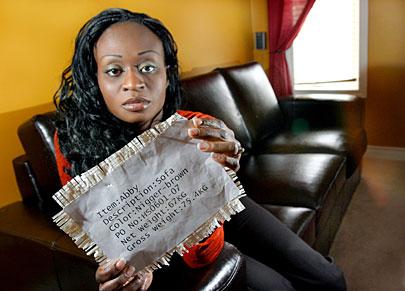
Racial slur on sofa label stuns family

untitled

JIM WILKES/TORONTO STAR
April 6, 2007

Doris Moore's 7-year-old daughter, Olivia, spotted this label on covering around a new sofa set.

When the new chocolate-coloured sofa set was delivered to her Brampton home, Doris Moore was stunned to see packing labels describing the shade as "Nigger-brown."


She and husband Douglas purchased a sofa, loveseat and chair in dark brown leather last week from Vanaik Furniture and Mattress store on Dundas St. E.

Moore, 30, who describes herself as an African-American born and raised in New York, said it was her 7-year-old daughter who pointed out the label just after delivery men from the Mississauga furniture store left.

"She's very curious and she started reading the labels," Moore explained. "She said, `Mommy, what is nig ... ger brown?' I went over and just couldn't believe my eyes."

She said yesterday each piece had a similar label affixed to the woven protective covering wrapped around the furniture.

"In this day and age, that's totally unacceptable," Moore said.

Douglas explained the origins of the word to daughter Olivia, telling how it was a bad name that blacks were called during the days of slavery in the United States.

"It was tough, because she really didn't understand," Moore said. "She'd never heard that word before and didn't really understand the concept of it."

Moore, who has a younger son and daughter, said she's heard the word used many times, although it has never been directed in anger at her.

"But it's a very, very bad word that makes you feel degraded, like you're a nobody," she said.
Moore said she called the furniture store the following day and three other times since, and feels discouraged that no one has returned her calls.

When interviewed yesterday by the Star, Romesh Kumar, Vanaik's assistant manager, passed the buck to his supplier, Cosmos Furniture in Scarborough.

"Why should I take the blame?" he said. "I'm a trader, I don't manufacture. I sell from 20 companies, maybe 50 companies. How can I take care of all of them?"

He said that he would check similar stock and make sure other labels were removed.
"That's terrible, that's a racial ... something?" Kumar said. "This is entirely wrong, but it's not my fault. It's my job to sell good product to people."

He said the best he could do is to give Moore the telephone number of his supplier, so she could take it up with him.

The owner of Cosmos Furniture, Paul Kumar, no relation to Romesh, said he was upset to learn packing labels on products he sold carried a racial epithet.

"I import my products from overseas," he said. "I've never noticed anything like that. This is something new to me."

He passed the blame to a Chinese company, but apologized for the labels. He said he would contact the furniture maker in Guangzhou and demand they remove all similar labels.
Moore said she's not sure she wants the sofa set in her home.

"Every time I sit on it, I'll think of that," she said.

Monday, June 04, 2007

auditions

dunkin donuts audition today. an audition to understudy celie in the broadway company of "the color purple" tomorrow. absorbing three scenes and two songs for that audition right now, and musicwise all they gave me was sheet music. i didn't have the money or the time to track down a pianist or find it in the performing arts library or locate a musical theater-obsessed friend with the original cast recording, which meant having to cough up twenty bucks for the cd. i should have been annoyed and some part of me was, i suppose. but ultimately, i was too grateful that i could afford to pay for it.

yes, it's true. being able to pay all my bills on time and having health insurance feels wierd. you know what else? having to learn this stuff all at once feels like i've entered a pie-eating contest. just thinking about doing a musical theater audition makes me a little queasy. no small wonder. when i go in, they know me or they've heard of me, so i've got to give them something of a performance and that means i have to know the lines and material i just got the night before, even if they sit there and say it's okay that i don't. i'm exhausted just imagining what i'd have to do, to pull that off. i mean, really. feh.

i remember what it was like when i first came to nyc. getting the audition, finding appropriate sheet music, learning the material, finding something decent to wear -- that was the tip of the iceberg. they wouldn't let me into the union auditions because i was non-union. i had to wait until they'd seen all of the union people on the list and then they'd say, we've seen enough, please leave your headshot in this box, thanks. or they'd say only the first ten people on the non-union list, thanks -- and i'd be number 11. or they'd say dancers who sing only, everyone else -- thanks. there was always that bouncy, overly enthusiastic thanks at the end, which to my ears sounded a whole lot like get out. funny thing, though. i got good at auditioning. i guess i had to, what with all of that going on.

i was working it off broadway and i was writing songs and in and out of bands while i was in and out of auditions like that. my non-union status went on for six years before i landed the first national tour of RENT on a straight-up non-union cattle call. i guess all those non-union wait-all-day-and-get-nothing auditions were preparing me for that one because it was a motherlode.

wow. why didn't i quit?

Wednesday, May 30, 2007

the day after that

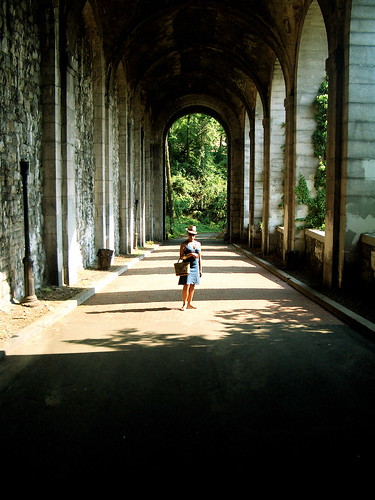
queen esther in ft. tryon park

nyc can be so beautiful, sometimes. the filth they're always showing in the movies and on television doesn't ever measure up to the real thing when it's this breathtaking and simple. this is me in fort tryon park -- a place that looks and feels a lot like my parents' backyard in atlanta.

actually, in my first few years of living in nyc, i would take the train to this park and wander through it until i got to the cloisters, because it was a "pay what you wish" situation and i was all kinds of broke. it was the same deal at the met. i always thought of that place as especially spectacular because it was basically five museums in one. and believe me, i treated it like it was my very own palace. when i didn't have enough money to get on the subway and head to that glorified castle near the end of the A line, i would walk across the park and spend all day getting lost in the post-Impressionist wing, staring at my favorite one, but mostly scheming and making lists and daydreaming about my future in nyc and what it might be like.

i always thought that the cloisters are a bright shining example of what people should do with their money when they're really loaded.

later, when i had two nickels to rub together, the met was the first museum i joined. but then i joined MoMA too -- because it was so unbelievably expensive but mostly because i'd been stuck in bauhaus for years and i really needed to learn about modern and contemporary art.

i think of any work of art as a kind of snapshot: a moment in time that captures something of the artist's life, the artist's essence. when i walk through any museum, i feel as though any one of them have been split open and emotionally disemboweled right in front of me. kandinsky makes me feel that way. so does de kooning. and rauschenberg. a live performance, a song, a recording should do the same thing. seeing emmylou harris at joe's pub and listening to her sing red dirt girl made me blink back tears. i don't know if it's me or what but i don't hear a lot that moves me. i can still get lost in what i see, when i wander through a museum. and then certain pictures become touchstones in the same way that i can get so emotionally tangled up in a song or a particular lyric. so when i go, i want to see certain ones and get that particular feeling all over again.

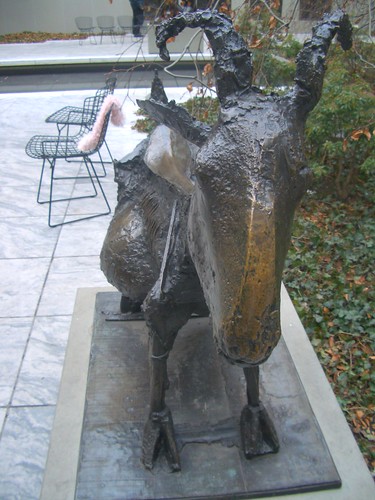
i think i made the beginnings of pre-production plans on my next cd while sitting next to picasso's goat in the rock garden at MoMA. i like that goat. it looks unhinged. besides, i have an uncle with a farm in walterboro that has a lot of goats. if i could have a pet, it would be a goat. so until i get back down south, this one will have to do.

picasso's goat

at first, i went to museums because i wanted to see the art that i'd been looking at in textbooks all of my academic life. and then i went because it helped me to think through ideas in this really expansive way. now i get it: it's occupying one part of my brain while another part is ticking away like a metronome. and some other part of me is exploding...

Saturday, May 26, 2007

the day before the day before the first day of summer

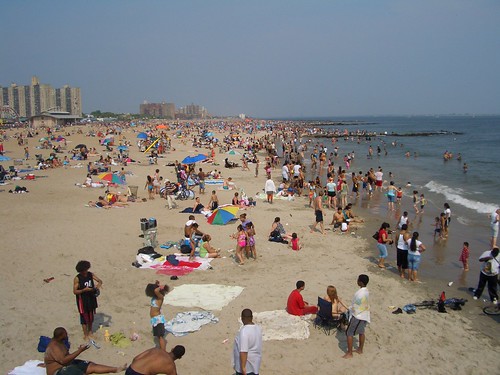
coney island, memorial day weekend

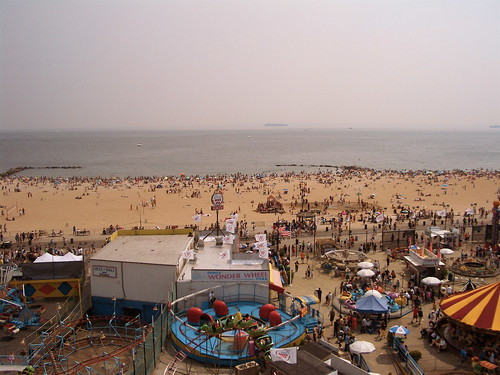
i wanted us to get away to a place that would make us feel as though we had actually gotten out of the city without actually having to leave -- so we went to coney island. i'd never been there before but i'd heard lots of stories about it when i was a little kid from my father, who still occasionally waxes poetic now, at the grand old age of 90, about the fun he'd had there as a young man. the question floated before me like a mirage: would i see any of the coney island that my father knew?

everyone on the train was so upbeat about being there. as we headed towards the water, we were surrounded by people of all ages in varying stages of undress. they wandered around strategically and ate all kinds of things, and spoke very little english -- to each other, at least. lots of sailors, too. (i totally forgot that it was fleet week.) and there were other things going on, too -- pretty girls on stilts waving little flags, a tatooed lady here and there, some guy with a puppet that sang and sang. it was a permanent oceanside carny, not unlike any i'd seen and performed in when i lived in texas. too bad there was no frito pie.

sure there was no nathan's hot dogs in the panhandle but there was way better food. every stand seemed to offer the same things: roasted meats on a stick, italian sausages, hot dogs, french fries, hamburgers. fried chicken, fried clams, fried shrimp. fried, fried, fried, with nary a vegetable in sight -- unless you wanted some onions as a garnish. (and yeah, those were fried, too.) it was somewhat crowded, quite relaxed and just a little bit glorious. a punk rock three piece at one end of the boardwalk. a live latin outfit at the other end, with a crowd that leaned in to watch people dance. bad r&b blaring out at you as you passed some ride, some hit or miss game, some spin and barf with the added plus of letting you sail through the air over and over, like a well-controlled well-oiled slingshot. cleaner than average carny. and yes, after listening to story after story of how filthy all of it was supposed to be, the beach was surprisingly clean. it made me giddy, looking out onto that blue horizon line and drinking in all of that fresh breezy sea air and sunshine. my friend was like a tour guide, prattling off facts, leading me this way and that.

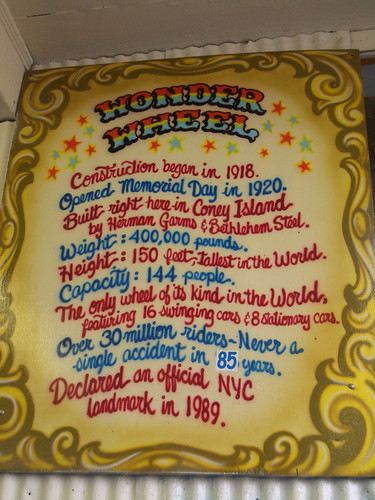
which ride would be first? the wonder wheel.

the wonder wheel

this was a piece of history that my father rode as a kid. how could i say no?

of course, i should have rethought that before i jumped on the cyclone. i think that thing realigned my spine. i'm pretty sure that if i'd eaten something substantial beforehand, i would have involuntarily flung vomit out of the pit of me, far and wide, in wide sloping technicolor streams of undigested glop that would arc high into the air just so and land, hot and steaming and merciless, on the unsuspecting heads and shoulders of most of the small children in the kiddie park directly below. but that's another story.

i'm glad i rode the cyclone and i'd probably do it again just to say that i did it but deep down i wish i hadn't. i should have known better when i saw how padded our seats were. heh.

coney island, up in the air

this is a shot from somewhere atop the wonder wheel.

afterwards, in spite of the fried greasy everything that everyone gorged themselves on, i found a stand that sold nothing but fresh chilled fruit. as we settled into the freak bar and wondered about the demise of coney island, i munched on sliced chilled mango. we fantasized about what it might be like to live out there, in some wide open space with a car, maybe. then again, maybe not. no grocery stores. high crime. high development. that's gentrification in new york city for you. in a few years or so, it'll be the place to live. and everyone who stuck it out and bought something will be saying, "i told you so." yeah. maybe.

my friend wouldn't take me to the sideshow because he said he'd had enough of freaks. and bars, too. i wanted to see chuy the dog-faced mexican. next time, he promised. and there has to be a next time because this is coney island's last time, or at least, it's the last gasp like this: old-school, wide-open, neo-burlesque, cheap, freaky fun.

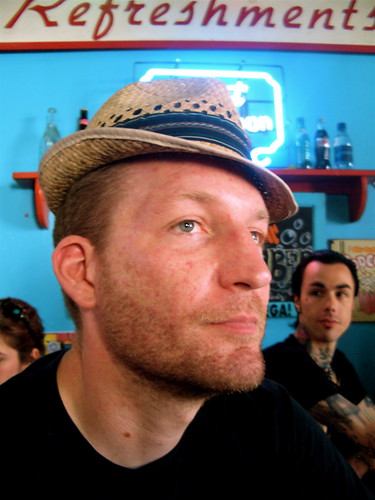
at the freak bar

from what i'd been told, this was coney island's last summer before a massive renovation that would sweep away much of the boardwalk and fill the strip with expensive condos that would stand in the shadow of the high rise projects nearby. in our walk along the dock that extended over the water, one of the city workers confirmed what i'd been told: coney island would be a playground for the rich. astroland would stay and so would the freaks, probably. the developers had even bought an old deserted bathhouse that we'd glimpsed just down the boardwalk. there was just no stopping them. what a mess. the question that no one can answer is, where will the poor people live?

so this is the beginning of summer. almost. do i look like i'm ready for it?

the day before the first day of summer

one thing is certain: happiness isn't something that happens to you. it's a choice. i'm really really happy right now. gleefully, giggle-out-loud, throw-my-hat-up-in-the-air, walking-around-smiling-for-no-reason happy. and so is my friend. in a way, it doesn't get any better than that.

Friday, May 18, 2007

le freak! c'est chic!

there are articles and books that talk about disco as a cultural phenomenon but i haven't really read anything that dissects the creative drive or the musicianship behind certain groups or producers. the overall presumption is that disco lacks both. nowadays most talk about disco like it was a strange, tacky blight on the american music landscape. but i never thought that about the group chic.


then came the book everybody dance: chic and the politics of disco by daryl easlea. of course the author is a regular contributor to Mojo, arguably the only music magazine worth reading these days. of course it's published by helter skelter located in london, a city that knows a good black american thing when they see/hear it. of course a brit would intellectualize what chic has done and give their music and their production aesthetic the respect that it deserves. of course.


here's a glimpse: a live performance from back in the day. even from this far away in time and online video, it feels like a party. (check out nile rogers' afro! i love it!)


Thursday, May 17, 2007

queen esther the photographer?

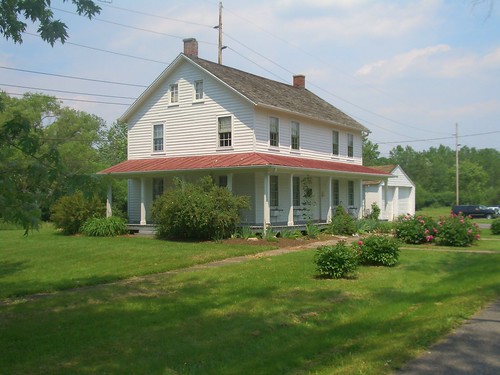
harriet tubman's house

i've got two photos that i took of harriet tubman's property last year that are going to be in a children's book about her, to be published by sterling publishing (this fall, i think). this one is her house.

i remember showing this photo to some black someone that i was doing theater with at the time and he gagged and blurted, you mean she didn't live in some lean-to shotgun shack somewhere out back or something?

no. she didn't.

at a time when it was illegal for black people to own property, william h. seward, the former governor of new york and a very close friend of hers, stepped in to make sure that she'd be able to purchase a plot of land in auburn -- a few miles on the same road as his place, actually. in their ongoing excavations/renovations of the property, they found the remains of a kiln that was located some distance from the house while i was there late last spring. as it turns out, her husband built a beautiful two story brick house there, from scratch. what was appalling is that her family lost the house right after she died because they didn't pay taxes on it. (!!!) one other family occupied the house until the mid to late 1980s. someone had the bright idea to turn her property into an historical site, amongst other things. it's still in the works. i hope it happens. as of yet, we don't have a national museum devoted to the black holocaust or our history as african americans.

her husband building that house from scratch wasn't that deep to me because i watched my grandfather do it in charleston, south carolina when i was a little girl. he used brick that had been discarded from a nearby construction site and made the beautiful four bedroom/two bathroom house that filled much of my childhood memories.

harriet tubman's home for the aged

this one is the home for the aged that she built to help the old and the sick.

i'm relieved that they're going to use the photos because they're really beautiful (it was a picture-perfect blue sky day when i took them) but also because they singlehandedly deconstruct a lot of myths about who she really was and how she lived her life in her last years. it's hard to get to know an icon but when it's someone that casts such a long shadow throughout our recent american history, you have to try.

seward was no slouch, by the way. not only was he was a lawyer, a new york senator, a globe-trotting diplomat and a secretary of state under lincoln (and andrew jackson) -- his mansion was a pit-stop on the underground railroad. there's an infamous letter that he writes to his wife (who was a quaker, interestingly enough) where he's positively giddy about everyone thinking he's this fine upstanding citizen and all and there's half a dozen runaway slaves hidden in his basement. i couldn't wait to wander around in this place. as luck would have it, i had my own personal tour guide who was absolutely delighted to answer all of my bumbling idiotic picayune annoying questions about architecture and family portraits and credenzas and such (stuff like, "where did sewell die?" "was it this fainting couch or that one?" "who found him?" "is this place haunted or what?" oh, and here's a real winner: "i know i can't sit in that inaugural carriage that seward and lincoln rode in - but can i touch it?") i figured they didn't bounce me out of there because i was featured in the hit musical in their town that summer and everyone was talking about it.

of course, they wouldn't let me take any pictures inside, but they did let me stand for a few minutes in that very room where those slaves hid. leaning against those walls had a strange effect on me. i could feel them resonating into my bones.

i thought that it was kind of fantastic that his house was a part of the underground railroad but from what i was told by my tour guide, there are lots of houses in auburn and in other towns upstate that were pit-stops, too: they were filled with hidden doorways, cabinets and bookshelves that moved to reveal some other room or that led to some other part of the house, unused cellars and attics. what an all-american treasure all of that is. i suppose there would be a movement to show those hidden rooms and such in those homes but people still live in them. someone should take pictures of them, at least. document them, somehow.

bizarrely, his mansion was also party central for a host of dignitaries and the like. i remember walking around thinking, how could you throw parties all the time and hide runaway slaves and never get caught? so yeah, i went a little nuts over the china, the furniture, the sitting rooms, those exquisite pocket doors and all of the beautiful decor from asia. (and there was a lot of it.) but i never forgot that hidden room. i love it when history stops wallowing in books and becomes real, even if it's in the form of some handmade bloody bedsheets that seward lay on while recieving medical care after that attack. all i could think was, this really happened! but more on that some other time.

so yeah, those photos. i'm not surprised that harriett tubman decided to settle in auburn. it's so close to canada and it's a really beautiful place. it's much more rural than i thought it would be -- lush and green and pretty -- but my friend kept calling it the suburbs anyway. with seward so nearby, she could own land and help others. and she did -- she opened a home for the aged. ironically, in her old age, she actually moved into it.

hm. i'll bet her husband built that house, too.

Wednesday, May 16, 2007

everyone's seen it but me

i'll figure out a way to post it here eventually but if you want to see the prego commercial that has me in it (it's actually called "rosemary and herb"), click here.

Wednesday, May 09, 2007

did you think i wouldn't get it?

to tell you the truth, i didn't think i would, either. but lo and behold, i got the comedy central promo -- afro and all, much to my father's surprise. (sigh.) we shoot it tomorrow. someone is calling me with details this afternoon.

i would kick up my heels right now and scream yippee!!!!!!!!!!! but later on today, i've got a look-see for Dell in midtown and an audition for a Deloitte industrial. i feel like i hit the ground running yesterday and my legs are still moving. more details as they unravel.

guess i'll have to scream and jump up and down on the inside.

Tuesday, May 08, 2007

where's the avalanche?

Not that I believe in this stuff or that I make a habit of reading it or that it means anything at all but this is what greeted me today in the horoscope section of MyYahoo.com:

"Your relationship with money is about to go through a very interesting phase. You'll be tasked with managing a far larger amount than you were prepared for, and you should not attempt to go it alone. The sums involved could cause you to make incorrect assumptions. If you don't understand something -- even something small -- seek out professional advice. These are murky waters, and you definitely don't want to get in over your head."

Mismanagement of funds, hm? Ha. I've been broke for so long, it would take an avalanche of money just to set me straight.

well, guess what?

got a call yesterday from my commercial agency. i'm on hold for that comedy central promo i auditioned for on friday. imagine that.

Monday, May 07, 2007

about that comedy central audition...

i got seen for a comedy central promo on friday. i didn't know exactly what that meant -- promo. i'm thinking, it's kinda like a commercial, right? no matter what it actually is, the audition will feel like a commercial one: i'll say the lines, they'll give me direction, i'll readjust -- but not too big -- and then maybe more direction, more readjustment, a thank you and i'm out. it's a routine that hardly ever changes with camerawork. no matter. i'm ready.

they said casual business attire. i wore a button front denim dress because i didn't have any cash money to run out and buy something to wear for the moment, like i usually did when all of my clothes were dirty. why didn't i have any clean clothes? because the elevator in my building is being upgraded and i didn't feel like hauling three large loads in a rickety cart up and down three flights of stairs. that's why. i waited until everything was dirty and it still wasn't fixed. oh, well.

which wig did i wear in my arsenal? did i do something extra-fancy with my natural hair? what about those cornrows? frankly, i didn't have the energy to bother. i decided to wow them with something really spectacular: my self. i came to this decision in part because of a conversation i had with my father, wherein i told him i got the prego commercial and that it was running but he probably wouldn't recognize me because i had that wig on (come on, you know the one) and then he told me that the reason why i got the prego commercial was because the wig made me look like a lady. then he said a lot of other stuff. like how he was kidding, and how i was supposed to be intelligent enough to know when he was joking. so i told him that i was completely daft but i knew enough to know that people say what they really mean when they're kidding around. and that was his passive-aggressive way of telling me what he thought of my hair. and why did i go for years wearing wigs to auditions and getting nothing. and yeah, he could give my mother the phone back now, and he's like, no, let's talk. and i'm like, i don't have anything to say to you. and that's when we were off to the races.

so when they called me in, i thought, you know what? i don't have the energy, the wherewithal, the time or the inclination to try to figure out what these executive corporate white people -- or my stubborn father, for that matter -- want me to look like as a black woman. they all think they know me, they all think they've got me figured out, and none of them do. especially my daddy. i mean, i've had it.

don't get me wrong. i'll work harder than anyone. i'll readjust. i'll wear a wig. why not? i like wigs. but this -- telling me in no uncertain terms that i'm patently unattractive because i don't straighten my hair -- this is over the top. the world tells me this every day but i don't listen. it shouldn't be a struggle to know that what i am is enough and to live that out in the ordinary moments of my world.

i know what you're thinking: it's just hair! but you know what? it's not. not when you're black and female.

so i showed up at liz lewis casting on time with a tight afro wearing a denim dress and some boots, took my polaroid smiling like mona lisa, and sat amongst gleamingly permed hair-dos and office casual outfits straight out of central casting until my name was called. i remember something about jack link. i remember having them pitch different office scenarios at me. i remember some white guy talking like mr. t at me, and me having to react to that, and everyone in the room laughing at what i did. wierd.

and then the next thing i knew, i was back on the sidewalk making my way through the breezy sunshiny streets, wondering what happened and somehow knowing exactly what happened. telling myself i didn't care -- and meaning it. i've always got way bigger catfish to skin and fry. it won't be the beginning of the world if i get it. it won't be the end of the world if i don't. but i would like to get it, just to leave my hair the way it is and in so doing, to silence my father -- if that's possible. and it isn't.

Sunday, May 06, 2007

so i didn't tell him

where did we go? to a town on the jersey coast called spring lake, to a bed and breakfast called the victoria house. i think it took a whole day just to relax. on saturday, we rode no speed cruiser bikes all day like a couple of nine year olds, from belmar to point pleasant and back again. our innkeeper said we must have put in something like 20 miles, easily.

and now i have to go play guitar and watch adult swim. more later.

Thursday, May 03, 2007

he doesn't want to know

heading out of town tomorrow with my friend, to celebrate his birthday. we're going to a place that neither of us has ever seen. he has absolutely no idea where we're headed. when i would offer to tell him, he would balk and demand that i stop talking. i told him to pack a toothbrush and some walking shoes -- and an appetite, of course. with any luck, we'll be back early on sunday afternoon.

this getaway is as much for me as it is for him. i need to get out of the city for awhile. i'm totally burnt out.

remarkably, everything is going spectacularly well. the guitar lessons and the guitar playing are coming on strong and so is the songwriting, i got two new cookbooks that i can't stop salivating over, the bike arrived from my friend's mother (thank you, thank you, thank you) and i had an audition today for a comedy central promo. here's the kicker: i just washed all my clothes, so i've got a whole new wardrobe.