Showing posts with label racial divide. Show all posts
Showing posts with label racial divide. Show all posts
Monday, October 27, 2008
real americans
this footage was taken after a mccain/palin rally in strongsville, ohio.
and so was this footage.


Tuesday, April 29, 2008
Rev. Dr. Jeremiah Wright's NAACP Speech
I don't know about you, but i'm sick of conservatives and their scary controversial soundbites. i'm already seeing bits and pieces of Rev. Dr. Wright's interviews that are being distorted for the sake of summing it all up in a negative way for a 30 second blurb. after i saw his NAACP speech in its entirety (he's a tremendous orator), i wondered who else had bothered to do the same thing. So i thought i'd post the whole thing in sequence to make it easy for you, whoever you are -- and you can make up your own mind: is he right or wrong? is he nuts? or is he telling the truth?
------------------------------------------------------------------
Part One -- The Introduction
Part Two -- Rev. Dr. Jeremiah Wright's Speech
Part Three
Part Four
Part Five
Part Six
------------------------------------------------------------------
Part One -- The Introduction
Part Two -- Rev. Dr. Jeremiah Wright's Speech
Part Three
Part Four
Part Five
Part Six
Tuesday, December 18, 2007
black santa!
i was at work late at night in the bowels of my corporate situation, eating a late night dinner with a few members of my team. inevitably, the casual conversation turned to the christmas season and how careful we had to be when sending out wintertime salutations, to not offend anyone. it was important to keep it neutral and safe, with phrases like "happy holidays" and "season's greetings." saying something like "merry christmas" was completely out of the question.
"who would be offended by santa," joe the a.d. asked broadly.
"are you kidding me?" i blurted. "i know plenty of black people down south who would be like, 'i don't want my black child thinking some white man is going to come down our chimney and give them anything.' and i'm related to quite a few of them." strangely enough, i had just spoken to my sister-in-law who was readying her first child, a four month old boy, for his first photo with santa. over her dead body would it be a white one.
the looks on all of their faces as i said this was priceless. then came variations on the inevitable "i've never thought about it like that" remark. if i've said it once, i've said it a thousand times: tact is important, but so is honesty. don't soft-pedal it with white people. when the opportunity presents itself, let them have it -- but only if you're in the mood to do a lot of explaining. they just so happened to catch me at the right moment, probably because i love black santa a lot.
then again, i was raised in ATL and i know who matthew henson is, so black santa makes a lot of sense to me.
when i go home, i'm going to take a picture with black santa. it'll be next year's christmas card. when i told my friend, he seemed genuinely sad. "i want to take a picture with black santa," he said. hm. maybe we both will.
--------------------------------------------------------------------
Since 2003, the Mall at Prince Georges has hired a black Santa Claus to pose for pictures with children and adults. And since then, black families have traveled from across the county and from Washington, D.C., so their children can have pictures taken with a Santa who looks like them.
Keesha Crosby of Washington, D.C., has brought her 3-year-old son, Jayden, to take pictures with the Mall at Prince Georges’ Santa since he was born.
‘‘I bring him here because he identifies with a black Santa Claus,” she said at the mall on Saturday. ‘‘All the other media outlets publicize a Caucasian Santa Claus, and he doesn’t identify with that.”
Victoria Clark, marketing director for the Mall at Prince Georges, said because most Prince George’s County residents are black, the demographics most likely called for a black Santa.
She also acknowledged that the area’s demographics have been changing. According to U.S. Census Bureau data, black people make up 66.1 percent of Prince George’s County and Hispanic people accounted for 10.7 percent in 2005. In 2000, black people made up 62.7 of the county’s population and people of Hispanic origin made up 7.1 percent.
‘‘In the past we’ve had a Hispanic Santa, but we take it one year at a time,” she said. ‘‘So far there haven’t been any requests for a Latino Santa.”
However, Clark said she’s observed people of all backgrounds stop to take pictures with Santa.
‘‘I think that’s indicative of the fact that there are people who come out who aren’t necessarily seeking a black Santa,” she said.
Nicole Davis of Brandywine said she learned about the mall’s black Santa Claus from her sister, who has brought her children to the mall for the past few years.
‘‘This is the only location in the area that promotes an African-American Santa,” said Davis, who brought her daughter, 23-month-old Emma, to take pictures at the mall. ‘‘So we’re making it a tradition to come here every year. ... It’s important for a child to know that Santa Claus isn’t just one color.”
Jackie Irvine of Atlanta, who tagged along while her two grandsons waited for their turn to take their pictures, said she began the tradition of taking pictures with a black Santa when her daughter, Kelli Neptune, was young.
‘‘I started taking her as a child to a black Santa and I had to travel to do so,” Irvine said of Neptune. ‘‘As a cultural figure, Santa represents kindness ... and I always wanted her to associate those attributes with a Santa Claus who shared her ethnicity and culture.”
Neptune, a Bowie resident, said she’s passing the tradition to her children who she hopes will pass the tradition on to their own.
‘‘I want my children to celebrate a Santa Claus that looks like them,” she said.
And her mother said it’s important for her grandsons to be able to identify with Santa.
‘‘I’m very glad to see him here and I think there should be Santas of every ethnicity all over Metro D.C.,” she said.
Santa will be available for pictures at the Mall at Prince Georges, 3500 East West Highway, until Dec. 24. Prices range from $15.99 to $39.99.
"who would be offended by santa," joe the a.d. asked broadly.
"are you kidding me?" i blurted. "i know plenty of black people down south who would be like, 'i don't want my black child thinking some white man is going to come down our chimney and give them anything.' and i'm related to quite a few of them." strangely enough, i had just spoken to my sister-in-law who was readying her first child, a four month old boy, for his first photo with santa. over her dead body would it be a white one.
the looks on all of their faces as i said this was priceless. then came variations on the inevitable "i've never thought about it like that" remark. if i've said it once, i've said it a thousand times: tact is important, but so is honesty. don't soft-pedal it with white people. when the opportunity presents itself, let them have it -- but only if you're in the mood to do a lot of explaining. they just so happened to catch me at the right moment, probably because i love black santa a lot.
then again, i was raised in ATL and i know who matthew henson is, so black santa makes a lot of sense to me.
when i go home, i'm going to take a picture with black santa. it'll be next year's christmas card. when i told my friend, he seemed genuinely sad. "i want to take a picture with black santa," he said. hm. maybe we both will.
--------------------------------------------------------------------
Some parents seek out a black Santa
Since 2003, the Mall at Prince Georges has hired a black Santa Claus to pose for pictures with children and adults. And since then, black families have traveled from across the county and from Washington, D.C., so their children can have pictures taken with a Santa who looks like them.
Keesha Crosby of Washington, D.C., has brought her 3-year-old son, Jayden, to take pictures with the Mall at Prince Georges’ Santa since he was born.
‘‘I bring him here because he identifies with a black Santa Claus,” she said at the mall on Saturday. ‘‘All the other media outlets publicize a Caucasian Santa Claus, and he doesn’t identify with that.”
Victoria Clark, marketing director for the Mall at Prince Georges, said because most Prince George’s County residents are black, the demographics most likely called for a black Santa.
She also acknowledged that the area’s demographics have been changing. According to U.S. Census Bureau data, black people make up 66.1 percent of Prince George’s County and Hispanic people accounted for 10.7 percent in 2005. In 2000, black people made up 62.7 of the county’s population and people of Hispanic origin made up 7.1 percent.
‘‘In the past we’ve had a Hispanic Santa, but we take it one year at a time,” she said. ‘‘So far there haven’t been any requests for a Latino Santa.”
However, Clark said she’s observed people of all backgrounds stop to take pictures with Santa.
‘‘I think that’s indicative of the fact that there are people who come out who aren’t necessarily seeking a black Santa,” she said.
Nicole Davis of Brandywine said she learned about the mall’s black Santa Claus from her sister, who has brought her children to the mall for the past few years.
‘‘This is the only location in the area that promotes an African-American Santa,” said Davis, who brought her daughter, 23-month-old Emma, to take pictures at the mall. ‘‘So we’re making it a tradition to come here every year. ... It’s important for a child to know that Santa Claus isn’t just one color.”
Jackie Irvine of Atlanta, who tagged along while her two grandsons waited for their turn to take their pictures, said she began the tradition of taking pictures with a black Santa when her daughter, Kelli Neptune, was young.
‘‘I started taking her as a child to a black Santa and I had to travel to do so,” Irvine said of Neptune. ‘‘As a cultural figure, Santa represents kindness ... and I always wanted her to associate those attributes with a Santa Claus who shared her ethnicity and culture.”
Neptune, a Bowie resident, said she’s passing the tradition to her children who she hopes will pass the tradition on to their own.
‘‘I want my children to celebrate a Santa Claus that looks like them,” she said.
And her mother said it’s important for her grandsons to be able to identify with Santa.
‘‘I’m very glad to see him here and I think there should be Santas of every ethnicity all over Metro D.C.,” she said.
Santa will be available for pictures at the Mall at Prince Georges, 3500 East West Highway, until Dec. 24. Prices range from $15.99 to $39.99.
Tuesday, December 04, 2007
a timely article
WILLIE HORTON AND ME
I am a black man. I am a young black man, born, let's say, between Brown v. Board of Education and the murders of Schwerner, Chaney and Goodman. Or, in the years that followed the murder of Emmett Till, but before the murder of Dr. Martin Luther King Jr. I am one of the young black Americans Dr. King sang of in his ''I Have A Dream'' speech: ''I have a dream that . . . the sons of former slaves and the sons of former slave owners will be able to sit down together at the table of brotherhood . . . that my four little children will one day live in a nation where they will not be judged by the color of their skin, but by the content of their character. . . . I have a dream today!''
Though I have a living memory of Dr. King, I don't remember that speech. I do remember my parents, relatives, teachers and professors endlessly recounting it, exhorting me to live up to the dream, to pick up the ball of freedom, as it were, and run with it, because one day, I was assured, we would look up and the dream would be reality.
I like to think I lived up to my part of the bargain. I stayed in school and remained home many nights when I didn't have to in the interest of ''staying out of trouble.'' I endured a lonely Catholic school education because public school wasn't good enough. At Notre Dame and Brown, I endured further isolation, and burned the midnight oil, as Dr. King had urged.
I am sure that I represent one of the best efforts that Americans, black Americans particularly, have made to live up to Dr. King's dream. I have a white education, a white accent, I conform to white middle-class standards in virtually every choice, from preferring Brooks Brothers oxford cloth to religiously clutching my gold cards as the tickets to the good life. I'm not really complaining about any of that. The world, even the white world, has been, if not good, then acceptable to me. But as I get older, I feel the world closing in. I feel that I failed to notice something, or that I've been deceived. I couldn't put my finger on it until I met Willie Horton.
George Bush and his henchmen could not have invented Willie Horton. Horton, with his coal-black skin; huge, unkempt Afro, and a glare that would have given Bull Connor or Lester Maddox serious pause, had committed a brutal murder in 1974 and been sentenced to life in prison. Then, granted a weekend furlough from prison, had viciously raped a white woman in front of her fiance, who was also attacked.
Willie Horton was the perfect symbol of what happened to innocent whites when liberals (read Democrats) were on the watch, at least in the gospel according to post-Goldwater Republicans. Horton himself, in just a fuzzy mug shot, gave even the stoutest, most open, liberal heart a shiver. Even me. I thought of all the late nights I had ridden in terror on the F and A trains, while living in New York City. I thought Willie Horton must be what the wolf packs I had often heard about, but never seen, must look like. I said to myself, ''Something has got to be done about these niggers.''
Then, one night, a temporary doorman at my Greenwich Village high-rise refused to let me pass. And it occured to me that it had taken the regular doormen, black, white and Hispanic, months to adjust to my coming and going. Then a friend's landlord in Brooklyn asked if I was living in his apartment. We had been working on a screenplay under deadline and I was there several days in a row. The landlord said she didn't mind, but the neighbors. . . . Then one day, I was late for the Metroliner, heading for Harvard and a weekend with several yuppie, buppie and guppie friends. I stood, in blazer and khakis, in front of the New York University Law School for 30 minutes, unable to get a cab. As it started to rain, I realized I was not going to get a cab.
Soaking wet, I gave up on the Metroliner and trudged home. As I cleaned up, I looked in the mirror. Wet, my military haircut looked slightly unkempt. My eyes were red from the water and stress. I couldn't help thinking, ''If Willie got a haircut and cooled out. . . .'' If Willie Horton would become just a little middle-class, he would look like me.
FOR YOUNG BLACKS of my sociological cohort, racism was often an abstract thing, ancient history, at worst a stone against which to whet our combat skills as we went winging through the world proving our superiority. We were the children of the dream. Incidents in my childhood and adolescence were steadfastly, often laughingly, overcome by a combination of the fresh euphoria of the civil rights movement and the exhortations and Christian piety of my mother. Now, in retrospect, I can see that racism has always been with me, even when I was shielded by love or money, or when I chose not to see it. But I saw it in the face of Willie Horton, and I can't ignore it, because it is my face.
Willie Horton has taught me the continuing need for a skill W. E. B. DuBois outlined and perfected 100 years ago: living with the veil. I am recognizing my veil of double consciousness, my American self and my black self. I must battle, like all humans, to see myself. I must also battle, because I am black, to see myself as others see me; increasingly my life, literally, depends upon it. I might meet Bernhard Goetz on the subway; my car might break down in Howard Beach; the armed security guard might mistake me for a burglar in the lobby of my building. And they won't see a mild-mannered English major trying to get home. They will see Willie Horton.
My father was born in a tar-paper, tin-roof shack on a cotton plantation near Holly Springs, Miss. His father was a sharecropper. His father had been a slave. My father came north, and by dint of a ferocity I still find frightening, carved an economic space for himself that became a launch pad to the Ivy League, to art school, to professional school, for his children.
As the song by John Cougar Mellencamp says it, ''Ain't that America. . . .'' But a closer look reveals that each of my father's children is in some way dangerously disgruntled, perhaps irrevocably alienated from the country, their country, that 25 years ago held so much promise. And the friends of my father's children, the children of the dream Dr. King died to preserve, a collection of young people ranging from investment bankers to sidemen for Miles Davis, are, to a man and woman, actively unsatisfied.
DuBois, in ''The Souls of Black Folks,'' posed a question perhaps more painful today than in 1903: ''Training for life teaches living; but what training for the profitable living together of black men and white?''
I think we, the children of the dream, often feel as if we are holding 30-year bonds that have matured and are suddenly worthless. There is a feeling, spoken and unspoken, of having been suckered. This distaste is festering into bitterness. I know that I disregarded jeering and opposition from young blacks in adolescence as I led a ''square,'' even dreary life predicated on a coming harvest of keeping-one's-nose-clean. And now I see that I am often treated the same as a thug, that no amount of conformity, willing or unwilling, will make me the fabled American individual. I think it has something to do with Willie Horton.
BLACK YOUTH CUL-ture is increasingly an expression of alienation and disgust with any mainstream (or so-called white) values. Or notions. Cameo haircuts, rap music, outsize jewelry are merely symptoms of attitudes that are probably beyond changing. My black Ivy League friends and myself are manifesting attitudes infinitely more contemptuous and insidious; I don't know of one who is doing much more on the subject of Dr. King's dream than cynically biding his or her time, waiting for some as-yet-unidentified apocalypse that will enable us to slay the white dragon, even as we work for it, live next to it and sleep with it.
Our dissatisfaction is leading us to despise the white dragon instead of the dragon of racism, but how can we do otherwise when everywhere we look, we see Willie Horton?
And we must acknowledge progress. Even in our darkest, most paranoid moments we can acknowledge white friends and lovers. I wouldn't have survived the series of white institutions that has been my conscious life without them. But it is hard to acknowledge any progress, because whites like to use the smallest increment of change to deny what we see as the totality. And, even in the most perfect and loving interracial relationships, racism waits like a cancer, ready to wake and consume the relationship at any, even the most innocuous, time. My best friend, white and Jewish, will never understand why I was ready to start World War III over perceived slights at an American Express office. In my darker moments, I suspect he is a bit afraid of me now. In my darkest moments, I wonder if even he sees Willie Horton.
Some of you are by now, sincerely or cynically, asking yourselves, ''But what does he want?'' A friend of mine says that the complaints of today's young blacks are indeed different from those of generations ago because it is very difficult to determine whether this alienation is a clarion call for the next phase of the civil rights movement or merely the whining of spoiled and corrupted minority elites who could be placated by a larger share in the fruits of a corrupt and exploitative system that would continue to enslave the majority of their brothers and sisters.
I don't think there is any answer to that question. I also think that the very fact it can be asked points to the unique character of the American race question, and the unhealable breach that manifests itself as a result in our culture and society. I don't think, for good or bad, that in any other ethnic group the fate of an individual is so inextricably bound to that of the group, and vice-versa. To use the symbol and metaphor of Willie Horton in another way, I do not think that the lives and choices of young white males are impacted by the existence of neo-Nazi skinheads, murdering Klansmen or the ordinary thugs of Howard Beach. I also, to put it plainly, do not recall any young black man, even those who deal drugs in such places, entering a playground and spraying bullets at innocent schoolchildren as happened in Stockton, Calif. It is not my intention to place value considerations on any of these events; I want to point out that in this society it seems legitimate, from the loftiest corridors of power to the streets of New York, to imply that one black man is them all.
And I want to be extraordinarily careful not to demonize Willie Horton. He should not be a symbol or scapegoat for our sins; he is a tragically troubled man - troubled like thousands of others, black and white - who was unwittingly used by a President to further division and misunderstanding. If anything, Horton is a particularly precise example of the willingness of those in power to pit us against one another. One lately fashionable statement, about to slide from truth to truism, is that blacks have the most to fear from lawless blacks. Any clear-eyed perusal of crime statistics will prove this. But what does it avail if the media, if the President, use this ongoing tragedy merely to antagonize and further separate Americans?
I THINK THAT WHAT I am finally angry about is my realizaton of a certain hollowness at the center of American life. Earlier, I mentioned the sense of having undergone a hoax. That hoax, as I now see it, is that the American community is putatively built upon the fundamentals of liberty and justice for all, that it is to be expected that the freedom to compete will result in winners and losers, and that the goal of society is to insure fairness of opportunity. In light of the events of recent years, I begin to see that we are, competing or not, winners or not, irrevocably chained together, black and white, rich and poor. New York City is a glaring microcosm of this interrelatedness, which can be thought of as either a web of fear ensnaring and enslaving us, or as a net of mutuality that strengthens us all.
As events like the Central Park rape illustrate, the world is becoming ever smaller, and it is increasingly difficult to consign social problems to realms outside our personal arenas of concern. I see the connection between Willie Horton and me, because it affects my own liberty. It was not always an obvious connection.
Another quote from Dr. King brings the issue into focus: ''. . . most of the gains . . . were obtained at bargain rates. The desegregation of public facilities cost nothing; neither did the election and appointment of a few black public officials. . . .'' To move to the next level of progress, we must face the fact that there are going to be costs, especially economic costs. To hire two black firefighters means two white firefighters won't be hired, and this is no easy reality. Racism is ultimately based on power and greed, the twin demons of most human frailties. These demons cannot be scapegoated, as the saga of Willie Horton proves. They are more like the Hydra, and will haunt our dreams, waking and other, regardless.
Tuesday, June 12, 2007
Racial slur on sofa label stuns family
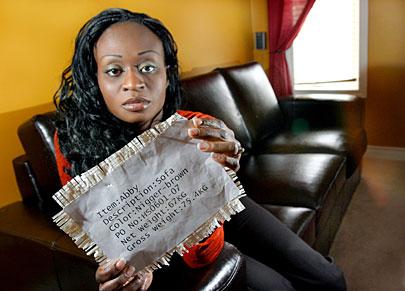
JIM WILKES/TORONTO STAR
April 6, 2007
Doris Moore's 7-year-old daughter, Olivia, spotted this label on covering around a new sofa set.
When the new chocolate-coloured sofa set was delivered to her Brampton home, Doris Moore was stunned to see packing labels describing the shade as "Nigger-brown."
She and husband Douglas purchased a sofa, loveseat and chair in dark brown leather last week from Vanaik Furniture and Mattress store on Dundas St. E.
Moore, 30, who describes herself as an African-American born and raised in New York, said it was her 7-year-old daughter who pointed out the label just after delivery men from the Mississauga furniture store left.
"She's very curious and she started reading the labels," Moore explained. "She said, `Mommy, what is nig ... ger brown?' I went over and just couldn't believe my eyes."
She said yesterday each piece had a similar label affixed to the woven protective covering wrapped around the furniture.
"In this day and age, that's totally unacceptable," Moore said.
Douglas explained the origins of the word to daughter Olivia, telling how it was a bad name that blacks were called during the days of slavery in the United States.
"It was tough, because she really didn't understand," Moore said. "She'd never heard that word before and didn't really understand the concept of it."
Moore, who has a younger son and daughter, said she's heard the word used many times, although it has never been directed in anger at her.
"But it's a very, very bad word that makes you feel degraded, like you're a nobody," she said.
Moore said she called the furniture store the following day and three other times since, and feels discouraged that no one has returned her calls.
When interviewed yesterday by the Star, Romesh Kumar, Vanaik's assistant manager, passed the buck to his supplier, Cosmos Furniture in Scarborough.
"Why should I take the blame?" he said. "I'm a trader, I don't manufacture. I sell from 20 companies, maybe 50 companies. How can I take care of all of them?"
He said that he would check similar stock and make sure other labels were removed.
"That's terrible, that's a racial ... something?" Kumar said. "This is entirely wrong, but it's not my fault. It's my job to sell good product to people."
He said the best he could do is to give Moore the telephone number of his supplier, so she could take it up with him.
The owner of Cosmos Furniture, Paul Kumar, no relation to Romesh, said he was upset to learn packing labels on products he sold carried a racial epithet.
"I import my products from overseas," he said. "I've never noticed anything like that. This is something new to me."
He passed the blame to a Chinese company, but apologized for the labels. He said he would contact the furniture maker in Guangzhou and demand they remove all similar labels.
Moore said she's not sure she wants the sofa set in her home.
"Every time I sit on it, I'll think of that," she said.
Thursday, March 01, 2007
all apologies
sorry i didn't post any pithy remarks about black history month in february. i'm usually so good about that stuff. the thing is, i don't walk around thinking about what a wonderfully uppity negress i am. to quote zora neale hurston, i'm too busy sharpening my oyster knife. actually, i don't think anybody spends a whole lot of time dwelling on their race or gender unless something happens that draws their attention to it. and if you're black, something is happening all the time. the difficulty is to not meditate on it.
when my blackness isn't brought to the forefront of my daily goings on, i'm thinking stuff like, i can't believe that i need four sets of boot trees or i'm almost out of vitamins or i'm not going to make it to jef lee johnson's show at the jazz standard next week or boy, do i love lobster bisque or i should call my grandma tomorrow. until something happens, i'm just another person, reaching for enough miracle whip for my sandwich. believe me -- the stupid things that can happen to people of color even in a place that's supposed to be as cool as nyc can turn anyone into a militant/activist. and in that regard, brothers and sisters, there's a little malcolm x (or a little betty shabazz) in each of us, no matter where we are in the world.
so here's a little cheat sheet of what's going on in my black world:
when my blackness isn't brought to the forefront of my daily goings on, i'm thinking stuff like, i can't believe that i need four sets of boot trees or i'm almost out of vitamins or i'm not going to make it to jef lee johnson's show at the jazz standard next week or boy, do i love lobster bisque or i should call my grandma tomorrow. until something happens, i'm just another person, reaching for enough miracle whip for my sandwich. believe me -- the stupid things that can happen to people of color even in a place that's supposed to be as cool as nyc can turn anyone into a militant/activist. and in that regard, brothers and sisters, there's a little malcolm x (or a little betty shabazz) in each of us, no matter where we are in the world.
so here's a little cheat sheet of what's going on in my black world:
- i need (yes, need!) three box sets: another one in the bob dylan bootleg series, willie dixon on chess and the layla and other assorted love songs 25th anniversary re-issue. listening to a lot of charlie christian and johnny cash these days, and i'm learning how to play bar chords and power chords.
- i love playing guitar so much, i've already picked out my next one: a beautiful scaled down A & L parlor guitar, in a strange shade of blue.
- believe it or not, i found a restaurant in east harlem called creole that serves real honest-to-goodness bona fide alligator etoufee.
- my friend and i are going to see new york divided: slavery and the civil war this weekend. (maybe we'll have gator afterwards...)
- congratulate me: i've finally perfected my ultra-southern sour-cream chocolate cake.
- i think i'll bake one and take it to abdul at a. bistro in brooklyn. i miss my african chef.
- i'm reading odimumba kwamdela these days. (if you've never heard of him, i highly recommend the semi-fictional novel/underground classic niggers, this is canada.)
- if you want to get a real taste of dany laferriere's work, skip the movie how to make love to a negro without getting tired and read the book. or if you want to see one of his movies, please do yourself a favor and go see heading south. it's effing brilliant.
- now that every available windowsill in my apartment has a thriving philodendron, i've decided to grow something that blooms: an amaryllis.
- i really need (!!!) to go see the allman brothers at the beacon this month, for march madness.
Wednesday, November 15, 2006
Racial Divide Still Evident
okay, maybe it's me. maybe i'm the only black woman out here that's a single college graduate with no kids that happens to earn as much if not more than the median white income level in this country, according to the latest census reports. but i don't think so. i think there's a jillion of us. so where are our stats?
who knows what my life would be like if i left new york city. let's face it: my rent is a mortgage payment. that's the next step: home ownership. or maybe graduate school. hm. let's see which one comes first.
-----------------------------------------------------------------------------
Racial divide still evident
Blacks, Hispanics lag behind in education, income levels
Tuesday, November 14, 2006
By STEPHEN OHLEMACHER
of The Associated PressWASHINGTON, D.C. -
Decades after the civil rights movement, racial disparities in income, education and home ownership persist and, by some measurements, are growing.
White households had incomes that were two-thirds higher than blacks and 40 percent higher than Hispanics last year, according to data released today by the Census Bureau. White adults were also more likely than black and Hispanic adults to have college degrees and to own their own homes. They were less likely to live in poverty.
"Race is so associated with class in the United States that it may not be direct discrimination, but it still matters indirectly," said Dalton Conley, a sociology professor at New York University and the author of "Being Black, Living in the Red."
"It doesn't mean it's any less powerful just because it's indirect," he said.
Home ownership grew among white middle-class families after World War II when access to credit and government programs made buying houses affordable. Black families were largely left out because of discrimination, and the effects are still being felt today, said Lance Freeman, assistant professor of urban planning at Columbia University and author of "There Goes the 'Hood."
Home ownership creates wealth, which enables families to live in good neighborhoods with good schools. It also helps families finance college, which leads to better-paying jobs, perpetuating the cycle, Freeman said.
"If your parents own their own home, they can leave it to you when they pass on or they can use the equity to help you with a down payment on yours," Freeman said.
Three-fourths of white households owned their homes in 2005, compared with 46 percent of black households and 48 percent of Hispanic households. Home ownership is near an all-time high in the United States, but racial gaps have increased in the past 25 years.
Asian Americans, on average, have higher incomes and education levels than whites. However, they have higher poverty rates and lower home ownership rates.
The Census Bureau released 2005 racial data on incomes, education levels, home ownership rates and poverty rates today. The data are from the American Community Survey, the bureau's new annual survey of 3 million households nationwide. The Associated Press compared the figures with census data from 1980, 1990 and 2000.
Among the findings:
who knows what my life would be like if i left new york city. let's face it: my rent is a mortgage payment. that's the next step: home ownership. or maybe graduate school. hm. let's see which one comes first.
-----------------------------------------------------------------------------
Racial divide still evident
Blacks, Hispanics lag behind in education, income levels
Tuesday, November 14, 2006
By STEPHEN OHLEMACHER
of The Associated PressWASHINGTON, D.C. -
Decades after the civil rights movement, racial disparities in income, education and home ownership persist and, by some measurements, are growing.
White households had incomes that were two-thirds higher than blacks and 40 percent higher than Hispanics last year, according to data released today by the Census Bureau. White adults were also more likely than black and Hispanic adults to have college degrees and to own their own homes. They were less likely to live in poverty.
"Race is so associated with class in the United States that it may not be direct discrimination, but it still matters indirectly," said Dalton Conley, a sociology professor at New York University and the author of "Being Black, Living in the Red."
"It doesn't mean it's any less powerful just because it's indirect," he said.
Home ownership grew among white middle-class families after World War II when access to credit and government programs made buying houses affordable. Black families were largely left out because of discrimination, and the effects are still being felt today, said Lance Freeman, assistant professor of urban planning at Columbia University and author of "There Goes the 'Hood."
Home ownership creates wealth, which enables families to live in good neighborhoods with good schools. It also helps families finance college, which leads to better-paying jobs, perpetuating the cycle, Freeman said.
"If your parents own their own home, they can leave it to you when they pass on or they can use the equity to help you with a down payment on yours," Freeman said.
Three-fourths of white households owned their homes in 2005, compared with 46 percent of black households and 48 percent of Hispanic households. Home ownership is near an all-time high in the United States, but racial gaps have increased in the past 25 years.
Asian Americans, on average, have higher incomes and education levels than whites. However, they have higher poverty rates and lower home ownership rates.
The Census Bureau released 2005 racial data on incomes, education levels, home ownership rates and poverty rates today. The data are from the American Community Survey, the bureau's new annual survey of 3 million households nationwide. The Associated Press compared the figures with census data from 1980, 1990 and 2000.
Among the findings:
- Black adults have narrowed the gap with white adults in earning high school diplomas, but the gap has widened for college degrees. Thirty percent of white adults had at least a bachelor's degree in 2005, while 17 percent of black adults and 12 percent of Hispanic adults had degrees.
- Forty-nine percent of Asian Americans had at least a bachelor's degree in 2005.
- The median income for white households was $50,622 last year. It was $30,939 for black households, $36,278 for Hispanic households and $60,367 for Asian households.
- Median income for black households has stayed about 60 percent of the income for white households since 1980. In dollar terms, the gap has grown from $18,123 to $19,683.
- Hispanic households made about 76 percent as much as white households in 1980. In 2005, it was 72 percent.
- The gap in poverty rates has narrowed since 1980, but it remains substantial. The poverty rate for white residents was 8.3 percent on 2005. It was 24.9 percent for black residents, 21.8 percent for Hispanic residents and 11.1 percent for Asian residents.
Thomas Shapiro, professor of law and social policy at Brandeis University, said the "easiest answer" to narrowing racial gaps is to promote home ownership, which would help minority families accumulate wealth.
"The wealth gap is not just a story of merit and achievement, it's also a story of the historical legacy of race in the United Sates," said Shapiro, author of "The Hidden Cost of Being African American."
Shelton, of the NAACP, called for more funding for preschool programs such as Head Start, improving public schools and making college more affordable.
"Income should not be a significant determining factor whether someone should have an opportunity to go to college," Shelton said.
---
On The Net:
Census Bureau: www.census.gov
Subscribe to:
Posts (Atom)