Showing posts with label africa. Show all posts

Monday, April 27, 2015

Selfie with a Supermodel!

Yep, that's Alek Wek, the South Sudanese model that started a revolution in the fashion industry at 18 (!!!) and compelled a young Lupita Nyong'o to stop begging God to make her skin lighter.  Our paths crossed in Times Square yesterday and, not surprisingly, she was sweet enough to let me take a snapshot.  She's a skinny little switch of a thing.  Her skin is so flawless, she's luminous.  And she was wearing a beautiful, bright, flowery dress that looked so spring-like, it knocked the chill right off of the rest of my day.

Now there's so many South Sudanese models (amongst others!) working in the fashion industry, it's not a thing to see such blue-black elegance drifting through any campaign, whether it's commercial or high end.  It's important to recognize that Ms. Wek was the one that blew that door off its hinges. She's an  ambassador, for all of us.

Hats off to the modeling scout that spotted her in London at a flea market with her mother when she was 18 years old.


What's interesting is that Ms. Wek never doubted her own beauty -- probably because as a child in the South Sudan, she wasn't surrounded by an avalanche of white-centric media.  Her confidence must have been infectious.

It still is.


Friday, April 24, 2015

How African Am I?

I always knew I was 100% African.  Always.  Every African I ever met knew it -- from the Nigerians I used to babysit for when I was a kid, to the Senegalese, Kenyan, Moroccan and Egyptian co-eds  I hung out with in college, to the South Africans I befriended when I came to the city, to the tailors from Ghana that made my wedding dress.  I have yet to meet any African that doesn't look at me in genuine astonishment as they recognize themselves or their mothers or sisters in me, and embrace me and all my African ways that never cease to amaze them and freak them all the way out. The food that I cook. The way that I dance. The gap in my teeth. My cheekbones. All of it.

Oh, some of them may want to exclude me because I'm American -- but my African face won't be denied.  And apparently, neither will the blood of my ancestors.  The blood, as Andre Crouch sang, will never lose its power. DNA doesn't lie.  And so it goes. 

As it turns out, according to AncestryDNA, I"m not 100% African. I'm 96% African. (Ha.)  And to think -- all those Five Percenters yelling at me in the street, calling me Nubia. They were right!  (Thanks, Brother-Men.)

Here's the breakdown:

Main Regions: "In order to be considered for this category, a region must have enough evidence that you actually have the region as part of your genetic ethnicity."

Cameroon/Congo =  29%
Senegal =  22%
Benin/Togo = 15%
Ivory Coast/Ghana = `14%
Nigeria =  5%

Trace Regions: "There is only a small amount of evidence supporting these regions as part of your genetic ethnicity. Because both the estimated amount and the range of the estimate are small, it is possible that these regions appear by chance and are not actually part of your genetic ethnicity."

Africa/Southeastern Bantu =  6%
Mali =  3%
Africa/South-Central Hunter-Gatherers = 1%
Africa North = 1%

Are you curious about that other 4%?  I'm not -- because it's so scant, they're probably showing up at random. (See Trace Regions.) 

I love all Africans everywhere -- from the Nigerians who squabble over which tribe I belong to ("Look at her! She's Igbo!") to the Haitians that assume at least one of my parents are from the West Indies (they are not); from the Parisians from the Ivory Coast and Senegal and Morocco and Egypt and the Sudan who call me "Soeur!" like that's my name to the stunning Cameroonian sisters who wave me down on 125th Street, friendly and out of breath and blurting French, asking for help, for directions probably, and genuinely flummoxed when I explain that I'm from America.  We hug each other and somehow I help them anyway.  And they leave me in the street, waving back at me, like we are family. Because we are.


I don't know what happened to us, as a people.  Well. We all know what happened, don't we.  Somewhere in the 80s, we became enthralled with a particular segment within a popular genre of music that was intrinsically divisive, glorified violence, denigrated black women with abandon and pandered to society's lowest common denominator to make a buck.  Eventually, that niche caught on with the white folks, became a garish caricature of itself in order to continue selling itself to the highest bidder and made a lot of white label executives a lot of money.

There. I said it.

When I was a kid, it was an ordinary every day thing that we called each other brother and sister -- and meant it.  Interestingly enough, it's a part of Chinese culture (many Asian and African cultures, actually) to address everyone this way. An older woman is aunt or mother, an older man is uncle or brother, someone your age is sister or brother or cousin. In this way, everyone is family and there is a unity inherent in the way you are spoken to that binds you to each other.   When we lost this simple unifying element, we lost each other.  And when we lost each other, we lost everything.

Well. At least now I know why my face has drawn all of the African diaspora to my heart. 

Friday, April 17, 2015

Your African Public Service Announcement of the Day

Please stop referring to Africa as a country.

Africa is a continent that has 54 countries.  Actually, it's the second largest continent and the second-most populated continent on earth, and with a population of 1.1 billion as of 2013.  Not surprisingly, thousands of languages are spoken there.

For more fun facts about Africa, click here.

You're welcome.

Friday, April 04, 2014

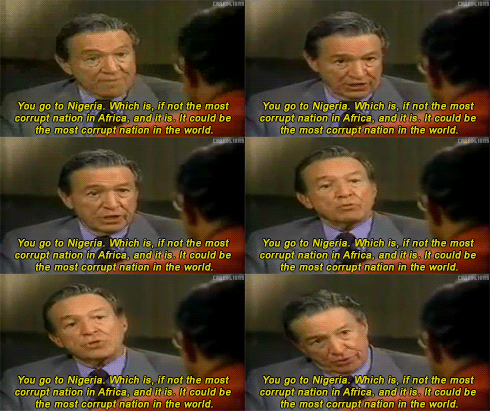
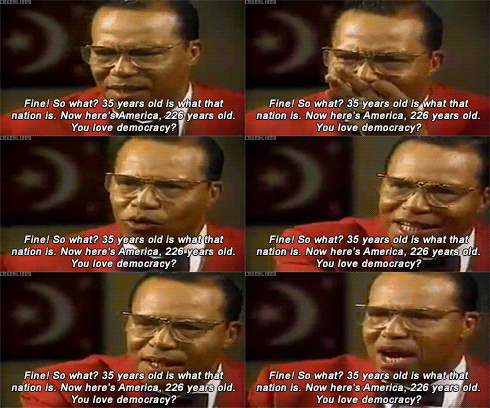
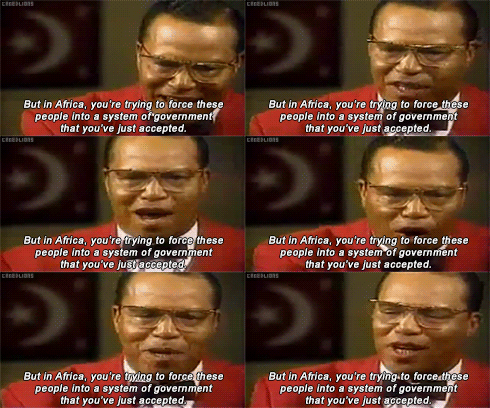
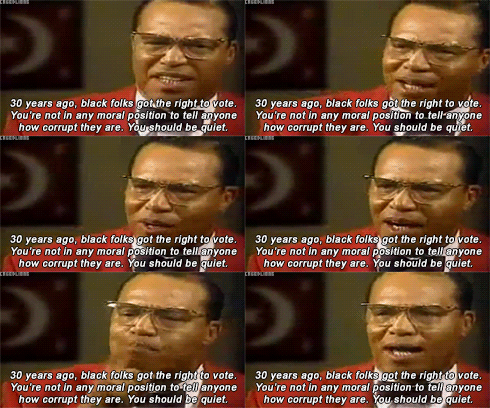
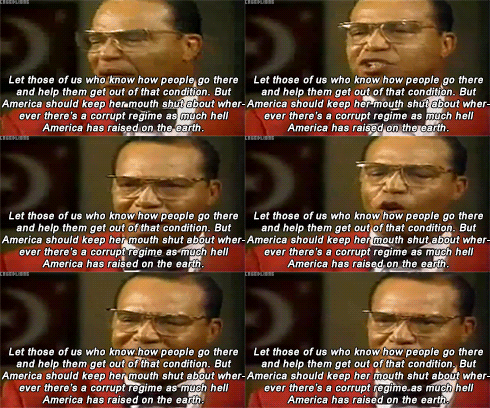
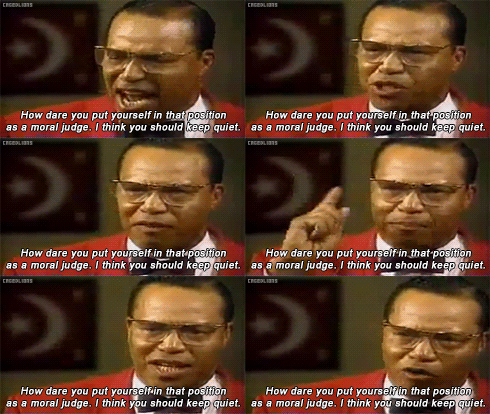
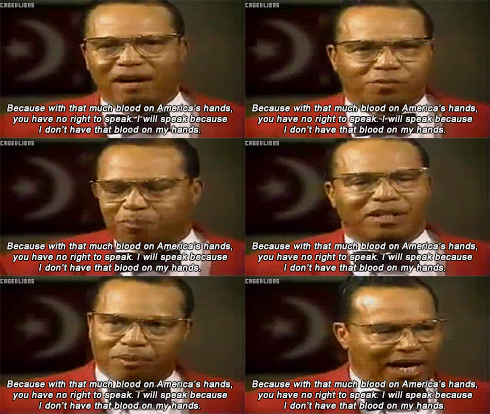
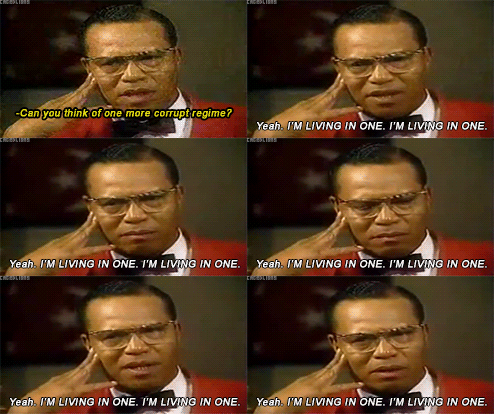
Truth and Soul - from The Honorable Louis Farrakhan

"There really can be no peace without justice. There can be no justice without truth. And there can be no truth unless someone rises up and tells you the truth." -- Louis Farrakhan

Here's Brother Farrakhan, serving up a nice heaping helping of truth to Mike Wallace, who can stay seated after positing that one-sided statement.


Monday, December 16, 2013

Girls Not Brides

Bill Gates recalls once being invited to speak in Saudi Arabia and finding himself facing a segregated audience. Four-fifths of the listeners were men, on the left. The remaining one-fifth were women, all covered in black cloaks and veils, on the right. A partition separated the two groups. Toward the end, in the question-and-answer session, a member of the audience noted that Saudi Arabia aimed to be one of the Top 10 countries in the world in technology by 2010 and asked if that was realistic. “Well, if you’re not fully utilizing half the talent in the country,” Gates said, “you’re not going to get too close to the Top 10.” The small group on the right erupted in wild cheering.


Astonishing but true: two thirds of the world's illiterate population are female.  In many countries, secondary education isn't free. In most poor families, if there's a choice between educating a daughter or a son, the boy goes to school and the girl labors in the fields and does housework.  The consensus is, girls leave (to raise their own families) and boys stay (to take care of their parents -- or at the very least, their mothers). Some girls are forced into marriage when they are as young as nine, with the tacit understanding that the husband won't have sex with them until they are of age. Quite often, they have sex with them, anyway. The results are often catastrophic.

Yemen must be hell on earth for little girls.  Then again, I suppose that when you're dirt poor, receiving a hefty pile of money to marry off your prepubescent daughters would be big business.  It's also tradition. 

The idea of putting girls first rankles a lot of people -- especially when it's African and South Asian girls.  The truth is, girls are denigrated all over in the world. Although Chinese girls are making great strides towards education in the cities, school is a rare luxury in rural areas.  And yes -- believe it or not, there's much work to do right here at home.

I loved books when I was a kid. My mother taught me how to read when I was 3 years old -- thank God.  By the time I hit kindergarden, I was on fire.


Thursday, October 24, 2013

Africa - It's bigger than you think!

with over a billion people that call the motherland their home, africa is almost 12 million square miles big.  but how big is that, exactly.  as it turns out, it's ginormous.

nothing like a visual to put it all in perspective...


Monday, June 04, 2012

30 days of birthday - day 4: june is black music month!

i have always believed that we africans of the diaspora have way more in common than we would probably dare to imagine.  music is just one of the many ties that bind us.  when i was in college, i loved juju music because it sounded so much like go-go music.  i met a lot of nigerians who agreed with me. i got to see king sunny ade when i was an undergrad in austin texas at the fabled liberty lunch. that was epic. one churning percussive groove after another, with absolutely no end in sight. he literally wore out the audience.  and so did the dancers. the only shows that i have ever seen that matched such heavy grooves so relentlessly (and that went on for so many hours, the audience left!) was parliament funkadelic.

when i fancied myself a budding journalist, i interviewed chief twins 77 for the campus' black student newspaper the griot. that was kind of a hoot. he was sitting there like a pasha, resplendent in these beautiful flowing robes and surrounded by musicians and dancers, and there were all these white people flipping out over his artwork, which was substantial.  one piece after another drifted past us as we chatted, with gobs of cash money changing hands and a lot of introductions and bowing from the white people and what not.  i didn't throw any cash around. nor did i bow.  at one point, he said that  i was a very pretty african girl. he said it flatly, in this really declarative way. he seemed to be genuinely surprised by this.  i have no idea why.

and then there was that time when that percussionist from chief ebenezer obey's juju band blurted out a marriage proposal instead of hello when he was introduced to me. he was beautiful, with a near perfect smile and deep scars layered across both of his cheeks. when i told him i'd seriously consider it if he gave me his talking drum -- an instrument that women are not allowed to play, under any circumstances -- he looked visibly stricken and scoffed loudly in his native language. later after he spent the evening onstage watching me dance, he reconsidered, joining me and my friends to dance with me.  eventually he returned to the stage and let me have the drumstick in this grand sweet gesture, declaring to the audience that he was going to take me home to his tribe. everyone clapped and screamed except me.

good times.

and no, i'm not a dancer. but when i was in the girl scouts, we had a black troop leader that was all about africa and black power and the soul in everything. i can recall many things we did for the community that involved african dance presentations with live drums and percussion. (one harvest dance in particular comes to mind.) it was a wonderful way to teach us about african culture and, in so doing, relate it to who we are as african-americans.  so when i dance, it's either jazz tea social dances from the 20s (boardwalk empire!), the lindy from the 30s or african dance. that's all i got!

needless to say, i forgot that june is black music month.  and because of chuck brown's untimely demise, juju and go-go have been on my mind and my stereo. for anyone who paused to wonder why the black side of dc grieved collectively last month when chuck brown -- grammy-award nominated guitarist/performer/legend and godfather of go-go -- passed away, the documentary below should set you straight.


...and this is a short informative documentary about juju music that explains it so succinctly, i wish i could use it to wallpaper my virtual world.


Saturday, January 31, 2009

the opportunity of a lifetime?

A brother and fellow Southerner sent me this notification the other day. He found it on Craigslist. Needless to say, I couldn't resist the urge to apply. When I responded to this, they sent me a questionnaire. When I sent the questionnaire, they gave me a call. A hearty round of phone tag ensued. I'm not sure, but I could be "it" at this point. Let's see what develops.

----------------------------------------------------------------------

HAVE YOU ALWAYS WANTED TO VISIT AFRICA? THIS CAN BE THE OPPORTUNITY OF A LIFE TIME.

A diverse group of African Americans (rich, poor, Northern, Southern, College Grad., High School Grad., Suburbia) are united on a trip to Africa to explore the Homeland. From townships and shanties to modern cities and skyscrapers, watch what happens when African Americans come face-to-face with the real Africa. Black to My Roots is a pilgrimage of personal and cultural discovery.

We are searching for a diverse group of applicants (Lawyers, Doctors, writers, hip hop artists, teachers, actors, nutritionists, fashionistas, etc). Please email a paragraph describing yourself and what makes YOU the ideal candidate for this opportunity, essentially what makes you UNIQUE.

Also, attach a photograph and your contact phone number. All entries must be received by 1/30/09. Openfocuscasting@gmail.com

Monday, January 14, 2008

sex tourism

this is an old story (it came out last november -- i thought i'd post it anyway) but not really. sex tourism has probably been around ever since someone invented the word "vacation." evidently, this sort of thing has been going strong in the west indies for quite some time. i fell into a conversation about it with a jamaican who told me that sex with the natives was the reason why lots of people travel to the carribean and it's an important part of their economies. once i did a little research, i realized that this was true of a lot of places all over the (third) world. but female sex tourism was something that i wasn't aware of. has anyone but me and a few of my friends seen the movie about female sex tourism in haiti called heading south? and hey -- what about how stella got her groove back? wasn't stella a sexual tourist in jamaica, an older woman of means looking to check out the "local talent," and then unwittingly scoring with that coveted beautiful younger man? the only difference is that stella took her prize home -- with disastrous results.

the world expects black women to be sexually demonstrative and aggressive but when white women behave that way, everyone gets nervous. clearly, the white female version of sex tourism is especially taboo. when the "white woman as sexual predator" concept makes everyone rethink the notion of sex with barely legal tender after turning a blind eye to the white male pedophiles who frequent southeast asia, it gives one pause to wonder.

would this be as offensive if it were white men pursuing african girls? is (white) female sexuality really that intimidating or disgusting? or maybe it's the fact that they're so blatant about it. i imagine that with a stronger European economy, we'll be reading more stories like this -- especially in other parts of Africa and with younger people.


------------------------------------------------------------------------


Older White Women Join Kenya's Sex Tourists
1 in 5 wealthy female travelers in search of young men, locals estimate


By Jeremy Clarke


MOMBASA, Kenya (Reuters) - Bethan, 56, lives in southern England on the same street as best friend Allie, 64.


They are on their first holiday to Kenya, a country they say is "just full of big young boys who like us older girls."


Hard figures are difficult to come by, but local people on the coast estimate that as many as one in five single women visiting from rich countries are in search of sex.


Allie and Bethan -- who both declined to give their full names -- said they planned to spend a whole month touring Kenya's palm-fringed beaches. They would do well to avoid the country's tourism officials.


"It's not evil," said Jake Grieves-Cook, chairman of the Kenya Tourist Board, when asked about the practice of older rich women traveling for sex with young Kenyan men.


"But it's certainly something we frown upon."


Also, the health risks are stark in a country with an AIDS prevalence of 6.9 percent. Although condom use can only be guessed at, Julia Davidson, an academic at Nottingham University who writes on sex tourism, said that in the course of her research she had met women who shunned condoms -- finding them too "businesslike" for their exotic fantasies.


The white beaches of the Indian Ocean coast stretched before the friends as they both walked arm-in-arm with young African men, Allie resting her white haired-head on the shoulder of her companion, a six-foot-four 23-year-old from the Maasai tribe.


He wore new sunglasses he said were a gift from her.


"We both get something we want -- where's the negative?" Allie asked in a bar later, nursing a strong, golden cocktail.


She was still wearing her bikini top, having just pulled on a pair of jeans and a necklace of traditional African beads.


Bethan sipped the same local drink: a powerful mix of honey, fresh limes and vodka known locally as "Dawa," or "medicine."


She kept one eye on her date -- a 20-year-old playing pool, a red bandana tying back dreadlocks and new-looking sports shoes on his feet.


He looked up and came to join her at the table, kissing her, then collecting more coins for the pool game.


"JUST UNWHOLESOME"


Grieves-Cook and many hotel managers say they are doing all they can to discourage the practice of older women picking up local boys, arguing it is far from the type of tourism they want to encourage in the east African nation.


"The head of a local hoteliers' association told me they have begun taking measures -- like refusing guests who want to change from a single to a double room," Grieves-Cook said.
"It's about trying to make those guests feel as uncomfortable as possible ... But it's a fine line. We are 100 percent against anything illegal, such as prostitution. But it's different with something like this -- it's just unwholesome."


These same beaches have long been notorious for attracting another type of sex tourists -- those who abuse children.


As many as 15,000 girls in four coastal districts -- about a third of all 12-18 year-olds girls there -- are involved in casual sex for cash, a joint study by Kenya's government and U.N. children's charity UNICEF reported late last year.


Up to 3,000 more girls and boys are in full-time sex work, it said, some paid for the "most horrific and abnormal acts."


"PREYING ON POVERTY?"


Emerging alongside this black market trade -- and obvious in the bars and on the sand once the sun goes down -- are thousands of elderly white women hoping for romantic, and legal, encounters with much younger Kenyan men.


They go dining at fine restaurants, then dancing, and back to expensive hotel rooms overlooking the coast.


"One type of sex tourist attracted the other," said one manager at a shorefront bar on Mombasa's Bamburi beach.


"Old white guys have always come for the younger girls and boys, preying on their poverty ... But these old women followed ... they never push the legal age limits, they seem happy just doing what is sneered at in their countries."


Experts say some thrive on the social status and financial power that comes from taking much poorer, younger lovers.


"This is what is sold to tourists by tourism companies -- a kind of return to a colonial past, where white women are served, serviced, and pampered by black minions," said Nottinghan University's Davidson.


"LIVE LIKE THE RICH"


Many of the visitors are on the lookout for men like Joseph.


Flashing a dazzling smile and built like an Olympic basketball star, the 22-year-old said he has slept with more than 100 white women, most of them 30 years his senior.


"When I go into the clubs, those are the only women I look for now," he told Reuters. "I get to live like the rich mzungus (white people) who come here from rich countries, staying in the best hotels and just having my fun."


At one club, a group of about 25 dancing men -- most of them Joseph look-alikes -- edge closer and closer to a crowd of more than a dozen white women, all in their autumn years.


"It's not love, obviously. I didn't come here looking for a husband," Bethan said over a pounding beat from the speakers.


"It's a social arrangement. I buy him a nice shirt and we go out for dinner. For as long as he stays with me he doesn't pay for anything, and I get what I want -- a good time. How is that different from a man buying a young girl dinner?"


(Editing by Daniel Wallis and Sara Ledwith)

Friday, June 15, 2007

now, this is democracy!

everyone else in the world has seen this. why not you? lions attack a baby buffalo with surprising results. my favorite moment? 5:49

makes you wonder what would happen in the world if we stood together like that.