Showing posts with label harriet tubman. Show all posts

Tuesday, February 02, 2016

The Real Harriet Tubman

 "I freed a thousand slaves. I could have freed a thousand more if only they knew they were slaves." -- Harriet Tubman


I LOVE Drunk History.  This episode describes The Combahee River Raid that freed more than 700 slaves, thanks to Harriet Tubman's brilliant strategies.  This show used to be a guilty pleasure but when they're telling the history that's usually ignored -- that is, when the drunk people are giving a more nuanced interpretation of what happened than what's usually taught in schools -- it should give everyone reason to pause, and tune in.  This should be required viewing for high school students. Whatever it takes to reach one and teach one, I'm all for it.

In a perfect world, there would be no Black History Month because if you tell the whole story, everyone is in it.  The problem is that, like Ben Affleck not facing his slave owning ancestry on PBS' Finding Your Roots by forcing the producers to erase it, Americans can't handle the ugly truth of how this country came to be. Instead, they tell their sanitized version, something they're comfortable with -- and ignore what actually happened.  Because white fragility.

You're not supposed to erase history or reimagine it because it makes you uncomfortable.


Until everyone can own their history -- Texas textbooks, anyone? -- Black History Month will be mandatory, for all of us.

If it's one name that gets thrown up in the air whenever it's time to teach black history, it's Harriet Tubman.  The sanitized version of her story is nothing in comparison to what actually happened. Context is everything -- especially when its historical. 

Here's a few fun facts that offer a glimpse of the real Harriet Tubman.
  • Her first name is Araminta. Everybody called her Minty.
  • Click here to read about how white people rented her out as a house slave from the age of five (her first job: winding yarn!) and how, amongst other things, she had to sleep on the kitchen floor at night and share leftover food with the dogs.
  • Minty was only five feet tall.
  • When she was an adolescent, Minty was inadvertently hit in the head by a 2 pound weight by her white master for not helping him restrain a runaway slave. It took her years to recover. This caused epileptic seizures, severe headaches and narcoleptic episodes that she endured for the rest of her life.

    In Bound for the Promised Land: Harriet Tubman, Portrait of an American Hero, Kate Clifford Larson writes:

    Bleeding and unconscious, she was returned to her owner's house and laid on the seat of a loom, where she remained without medical care for two days.  She was sent back into the fields, "with blood and sweat rolling down my face until I couldn't see." Her boss said she was "not worth a sixpence" and returned her to her owner Brodess, who tried unsuccessfully to sell her.  She began having seizures and would seemingly fall unconscious, although she claimed to be aware of her surroundings while appearing to be asleep. These episodes were alarming to her family, who were unable to wake her when she fell asleep suddenly and without warning.

  • Minty says that knock on the head made her hallucinate and gave her visions from God. 
  • Of course, she couldn't read or write.  The Slave Codes forbade it. Teaching black slaves -- as well as mulattoes, Native Americans and indentured servants, by the way  -- was punishable by severe fines, multiple lashes and more for the teacher, and much worse than that for the student.
  • A part of the reason why her master didn't pursue her or her family when they escaped to the North could have been because legally, they were free.  In their former master's will, her parents were manumitted at the age of 45 and so were their children. Their present owners simply didn't tell them and kept them working as slaves.
  • Minty's first husband, John Tubman, was a free man.  The mother's slave status determined whether any offspring would be slaves, which may be why they never had children.  She changed her name to Harriet when they got married, probably in preparation for her escape. 

Thursday, May 17, 2007

queen esther the photographer?

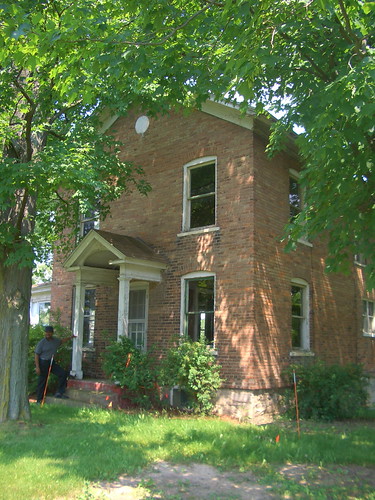
harriet tubman's house

i've got two photos that i took of harriet tubman's property last year that are going to be in a children's book about her, to be published by sterling publishing (this fall, i think). this one is her house.

i remember showing this photo to some black someone that i was doing theater with at the time and he gagged and blurted, you mean she didn't live in some lean-to shotgun shack somewhere out back or something?

no. she didn't.

at a time when it was illegal for black people to own property, william h. seward, the former governor of new york and a very close friend of hers, stepped in to make sure that she'd be able to purchase a plot of land in auburn -- a few miles on the same road as his place, actually. in their ongoing excavations/renovations of the property, they found the remains of a kiln that was located some distance from the house while i was there late last spring. as it turns out, her husband built a beautiful two story brick house there, from scratch. what was appalling is that her family lost the house right after she died because they didn't pay taxes on it. (!!!) one other family occupied the house until the mid to late 1980s. someone had the bright idea to turn her property into an historical site, amongst other things. it's still in the works. i hope it happens. as of yet, we don't have a national museum devoted to the black holocaust or our history as african americans.

her husband building that house from scratch wasn't that deep to me because i watched my grandfather do it in charleston, south carolina when i was a little girl. he used brick that had been discarded from a nearby construction site and made the beautiful four bedroom/two bathroom house that filled much of my childhood memories.

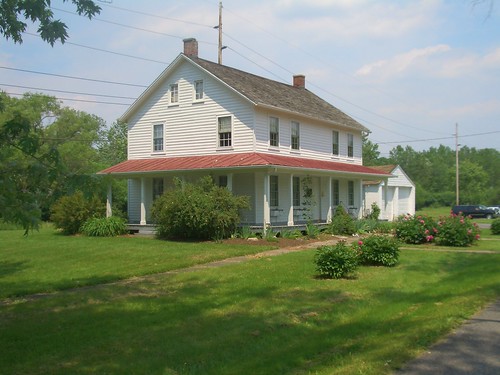
harriet tubman's home for the aged

this one is the home for the aged that she built to help the old and the sick.

i'm relieved that they're going to use the photos because they're really beautiful (it was a picture-perfect blue sky day when i took them) but also because they singlehandedly deconstruct a lot of myths about who she really was and how she lived her life in her last years. it's hard to get to know an icon but when it's someone that casts such a long shadow throughout our recent american history, you have to try.

seward was no slouch, by the way. not only was he was a lawyer, a new york senator, a globe-trotting diplomat and a secretary of state under lincoln (and andrew jackson) -- his mansion was a pit-stop on the underground railroad. there's an infamous letter that he writes to his wife (who was a quaker, interestingly enough) where he's positively giddy about everyone thinking he's this fine upstanding citizen and all and there's half a dozen runaway slaves hidden in his basement. i couldn't wait to wander around in this place. as luck would have it, i had my own personal tour guide who was absolutely delighted to answer all of my bumbling idiotic picayune annoying questions about architecture and family portraits and credenzas and such (stuff like, "where did sewell die?" "was it this fainting couch or that one?" "who found him?" "is this place haunted or what?" oh, and here's a real winner: "i know i can't sit in that inaugural carriage that seward and lincoln rode in - but can i touch it?") i figured they didn't bounce me out of there because i was featured in the hit musical in their town that summer and everyone was talking about it.

of course, they wouldn't let me take any pictures inside, but they did let me stand for a few minutes in that very room where those slaves hid. leaning against those walls had a strange effect on me. i could feel them resonating into my bones.

i thought that it was kind of fantastic that his house was a part of the underground railroad but from what i was told by my tour guide, there are lots of houses in auburn and in other towns upstate that were pit-stops, too: they were filled with hidden doorways, cabinets and bookshelves that moved to reveal some other room or that led to some other part of the house, unused cellars and attics. what an all-american treasure all of that is. i suppose there would be a movement to show those hidden rooms and such in those homes but people still live in them. someone should take pictures of them, at least. document them, somehow.

bizarrely, his mansion was also party central for a host of dignitaries and the like. i remember walking around thinking, how could you throw parties all the time and hide runaway slaves and never get caught? so yeah, i went a little nuts over the china, the furniture, the sitting rooms, those exquisite pocket doors and all of the beautiful decor from asia. (and there was a lot of it.) but i never forgot that hidden room. i love it when history stops wallowing in books and becomes real, even if it's in the form of some handmade bloody bedsheets that seward lay on while recieving medical care after that attack. all i could think was, this really happened! but more on that some other time.

so yeah, those photos. i'm not surprised that harriett tubman decided to settle in auburn. it's so close to canada and it's a really beautiful place. it's much more rural than i thought it would be -- lush and green and pretty -- but my friend kept calling it the suburbs anyway. with seward so nearby, she could own land and help others. and she did -- she opened a home for the aged. ironically, in her old age, she actually moved into it.

hm. i'll bet her husband built that house, too.