Showing posts with label documentary films. Show all posts
Showing posts with label documentary films. Show all posts
Friday, September 05, 2014
Joan Rivers, we hardly knew you...
Love her or hate her, one thing is certain: Joan Rivers -- a first generation Russian Jew from Brooklyn -- was a trailblazer and a genuine powerhouse that became a hit on The Tonight Show at 32 and never stopped working. Some performers hope for a victory lap in their old age -- a gig that allows them to step out into the spotlight and shine once more before they leave this world. Elaine Stritch had a wonderful victory lap. So did Alberta Hunter and Eartha Kitt. Joan Rivers, on the other hand, was sprinting around the track of life and when she checked out of here, her career was on fire. At the time of her passing, she had a reality tv show, a ridiculously popular youtube show (In Bed with Joan!) and a fashion talk show on E! Nevermind her stand up comedy appearances, her must-see red carpet interviews for the Golden Globes and the Oscars, and all that jewelry she was selling -- of her own design! -- on QVC. She wasn't just working. She was culturally relevant. That's a formidable accomplishment.
She finished at Barnard College with a major in English Literature and anthropology -- which seems ideal, in retrospect. She's one of the few comedians that actually wrote her own material. Actually, she wrote 12 books (!!!) and released several comedy albums. She didn't win every award out there but she was nominated for a Tony, a Grammy and won an Emmy in 1990 for her daytime talk show. And she's the first woman to host her own late night talk show on network television. Think about it: how many women have they allowed to take that coveted late night seat, to even co-host? Can you name three? Unless I'm seriously missing something, Joan Rivers is the only one I can think of.
After a certain point, I made a point of ingesting as many biographies, autobiographies, documentaries and Behind The Music episodes that I could. Everyone's trajectory is so revealing and important, and teaches so many lessons about what not to do and how this business really works. A part of it is a history lesson but what I look for is the cautionary tale that's inherent in just about all of them. The documentary Joan Rivers: A Piece of Work is essential must-see viewing for any performer. It's a glimpse into her work ethic and the anatomy of the machine that she built to propel her business of show forward. And somewhere in there is the Joan that hardly anyone ever thought they knew.
Godspeed, Joan Rivers. What a fantastic life you had. Long may you run.


Saturday, November 09, 2013
A new Jimi Hendrix documentary on PBS
I missed the new American Masters Jimi Hendrix documentary Hear My Train A Comin' on PBS the other night but thankfully, all is not lost. It's available online until November, 2017.
The very short clip above explores the origins of the Electric Lady recording studio. Its interesting to note that even though he was in the eye of a pretty tumultuous storm of rock and roll excess, Jimi Hendrix realized that he needed a place to record his music -- and before he left this world, he made sure that he created it.
Friday, October 11, 2013
The International Day of the Girl
I love documentaries.
Girl Rising is a doc directed by Oscar-recipient Richard Robbins that takes 9 girls from 9 countries and pairs them with 9 actresses -- Cate Blanchett, Selena Gomez, Anne Hathaway, Salma Hayek, Alicia Keys, Chloe Moretz, Freida Pinto, Meryl Streep and Kerry Washington -- to narrate their incredible life stories.
The cold, hard facts about girls and education in Pakistan are abysmal. Clearly Malala Yousafzai had -- and still has -- a massively huge fight on her hands. This begs the question: what about the rest of the world?
Girls are denigrated, devalued and neglected in a myriad of ways, all over the world. They have an especially hard way to go in part because many cultures believe that daughters will marry and leave but sons will remain in the family. To their way of thinking, it's important for boys to be educated so they can get good jobs. Girls should know how to cook and clean, to prepare them for the husbands and children -- and that mother-in-law -- that they'll eventually have to take care of and the household they'll have to run. And that's that.
I'm sorry but to my ears, that sounds like a Southern way of life. More on that some other time.
In over 100 countries, you have to pay for your children to attend school. If you're in sub-Saharan Africa and you have a boy and a girl with only enough money for one child, guess who gets to go?
Not only are girls valued as hard workers around the house and in the fields, they also fetch a high price as virgin child brides -- the younger they are, the more money they bring (probably because their virginity is insured). Fourteen million girls get married worldwide every year. That's over 38,000 girls every day -- or if you prefer, 13 girls in the last 30 seconds. Some of them are as young as 11 years old. The story of Nujood -- married off at the age of nine to a man more than three times her age and raped on her wedding night -- pretty much sums it up. Not surprisingly, the number one cause of death in the world for girls from 15 - 19 is childbirth.
Stats here at home in the USA aren't as great as you might think. We have the highest rate of teen pregnancy in the developed world. Over 50% of Native American girls, 4 out of 10 Latinas, and 4 out of 10 girls of color do not complete their education.
Anyone that thinks that focusing on what girls so desperately need somehow takes anything away from what boys are already getting doesn't really understand the enormity of the problem.
Sunday, September 15, 2013
Four Little Girls (and Condi, too)
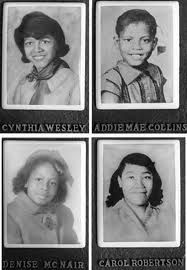
Fifty years ago today at about 10:22am, the 16th Street Baptist Church in Birmingham, Alabama was bombed by four active members of the Klu Klux Klan, an American terrorist organization. Their names were Robert "Dynamite Bob" Chambliss, Herman Cash, Thomas Blanton and Bobby Cherry. They belonged to a splinter group of the KKK of about a dozen members called The Cahaba Boys that met every Thursday night near the Cahaba river to drink beer and gripe about ridding the south of Catholics, Jews and black people. Why did they create a splinter group? Because they didn't feel that the Klan was radical enough. This, at a time when the city of Birmingham was called Bombingham (by us, of course -- because it was happening to us) because since the mid 1940s, so many homes and churches in the African-American community were getting blown up on a regular basis with no federal government intervention whatsoever. And of course, all of the bombings were officially unsolved cases.
Very few people know that Condoleezza Rice -- the first black woman to serve as the United States' national security adviser, as well as the first black woman to serve as U.S. Secretary of State (2005 - 2009) -- could very easily have been one of those little girls.
A native of Birmingham, Condi was an only child to a teacher and a Presbyterian minister, both of whom were well-educated in historically black colleges, staunchly middle class and Southern natives, having survived the Great Depression and some of the worst racism this country had to offer. They both knew the importance of a formal education and constantly stressed this to their child. Initially home schooled (are you surprised by that one?) Condi's mother went so far as to enroll her in the first grade when she was 3 years old. She could read music before she could read.

She was 8 years old when her playmate Denise McNair -- 11 years old at the time -- was killed in the bombing. Denise attended preschool at Condi's father's church, where he was a pastor. When Condi was 11, her family relocated to another city in Alabama and shortly thereafter, to Denver, Colorado and then finally to Palo Alto, California. And the rest is history.
I wonder: If those southern white terrorists knew that bombing that church would have caused the passage of the Civil Rights Act of 1964, would they have done it anyway?
Here's a 1997 interview of filmmaker Spike Lee for 4 Little Girls -- his first feature length documentary. Interestingly, it was an article he read in the New York Times Magazine in 1983 when he was a first year film student at NYU that prompted him to make this movie. His thoughts about how the movie got made are also very telling.
Documentaries are so important. These girls would be lost to history books if Mr. Lee hadn't made this one.
A few days ago, the Congressional Gold Medal was given to the families of the four girls -- the highest honor a civilian can receive. Somehow all of that rings hollow, especially in light of the fact that Carolyn Bryant -- the woman who pointed out Emmett Till to her husband and brother-in-law from the backseat of a sedan -- is still alive and well at 74 years of age and relaxing comfortably with her loving family in Greenville, Mississippi. She's an accessory to his murder. Why has she never been prosecuted? Why isn't she in jail?
As if on cue, Congressman John Boehner wept openly during that Congressional Gold Medal ceremony. When they prosecute Carolyn Bryant and many others like her for their crimes against African-Americans during the civil rights movement, I'll believe the sincerity of his tears.
Sunday, February 03, 2013
A Sick American in Dresden
Someone said to me recently – I think it was Charles Burnham
– that the ailments that visit you in your 30s and 40s come back to stay with
you in your old age. I haven’t had any visitors – and I’m not keeping the porch light on for houseguests,
either. This little story is a strong example of what it means to stay vigilant
and fight for your good health.
Because I’m fairly in tune with my body, I’m acutely aware
when something is wrong. While on tour in Dresden, Germany, I was quite
suddenly in so much pain with what I thought was an earache that I asked to see
a doctor. It felt as though a needle
was pushing its way directly into my ear canal, causing a shooting pain that
ran down my neck. My voice remained unaffected – but how long would that
last? I didn’t want to wait to
find out.
I had never had emergency medical care by a general
practitioner in Europe. What would this experience be like in comparison to
what I usually get in America when I’m uninsured?
Eva (our Austrian tour manager) got a few phone numbers from
the hotel and made an appointment to see a doctor on a Friday after 8am, when
their offices opened. When I saw
her at breakfast, she said I was in line to be seen as soon as possible. Thanks to a childhood that included way
too much art house cinema, this remark filled my head with images of starving
desperate filthy eastern Europeans in endlessly long breadlines, shrouded by
snow and grey skies wrapped gently within an overall sheen of desolation and despair. Our leisurely sun
drenched10 minute walk to the doctor’s office was quite the contrast. We even marveled at the beautiful
architecture as we went along.
There was a line, as it turns out – but it wasn’t what I
expected. It felt as though we were waiting to check out a book from the
library. We stood in a clean, well-lit vestibule with a few others for awhile
and then suddenly we were at a desk explaining ourselves to a sweet faced girl
in white who took my information and led us to a waiting room. In no time at
all – something like 15 minutes, maybe? -- I was sitting in the doctor’s
office. He was a little on the young side, a boyish looking 40-something
perhaps, smiling and open and friendly, and was dressed in jeans and a dark,
striped, button down shirt. I sat in a chair next to his desk, which was
expansive and well-organized, and he leaned back in this huge ergonomically
correct chair and listened to me attentively as I pointed at my neck and
gesticulated. Needless to say, his English was perfect. The whole thing felt
like a job interview. Or a really terrific blind date. We should have been
having coffee and pastry as we chatted. Sitting there, looking at him in his
black crocs, I couldn’t help but wonder: Where were his many, many degrees from
expensive inaccessible universities? Shouldn’t they have been hanging on the
wall behind him, constantly reinforcing his authority and expertise? Where was
his equipment? Wasn’t he supposed to be wearing a stethoscope or something? How
about some id tags? And where was his white jacket?
When I asked him this last question, he laughed. “Yes,
that’s right,” he said casually. “I wore a white jacket in Canada…” Equipment? He nodded toward the
bookshelf behind me, where a stethoscope sat on a shelf, glistening in the
phosphorescent light like an overfed garden snake. As I regaled him with stories of American doctors and
hospitals and how this might work if I were stateside, he examined my neck and
throat and listened with interest. He seemed bemused.
Then came the diagnosis. My ear was fine. My voice was fine.
The tube that runs from my ear to my throat -- the Eustachian tube -- was infected. How did this happen?
“Have you had a cold?”
he asked.
“No,” I replied. I honestly couldn’t remember the last time
I’d had a cold. I even made sure that I got my annual flu shot before I left
home.
“Was your nose clogged, was your head congested at
all?” he asked.
That’s when it hit me. I had been crying constantly for
days. This is all Jef’s fault.
The doctor wrote a prescription for nose drops and a cream
that is to be inhaled with steam. And with that, our visit was over as abrubtly
as it began. If I was in that room longer than 10 minutes, I’ll eat my favorite
pumps.
Here’s the upshot: I presented myself as a foreigner, I gave
them NO insurance information – just my passport. That little visit cost me 30
Euros. The medication was only 15 Euros. That’s something like $60. Even if the
rate of currency was 2 of our dollars for every one of theirs, I would still
have paid less than $100. We were in and out of there in less than an hour. I
was more than astonished. I was impressed.
I remember sitting in the van as we zipped down the highway,
more than just a little freaked out as I considered the American no insurance
alternative: sitting in the triage section of an emergency room’s waiting area
for hours on end, eventually sifting through a stack of paperwork only to wait and wait and wait until a
doctor sees you, hurls you through some expensive equipment if you’re lucky or
tosses some Tylenol at you if you aren’t.
That bill would be for hundreds upon hundreds of dollars. If you have
coverage, you’ll spend months haggling with the insurance company over it. If
you don’t have insurance, you’ll give a false name, address and social security
number, and then you will disappear. Or you will give them your correct
information and pay hundreds of dollars for what would have cost you less than
$50 in a place that used to be behind the Iron Curtain.
Would Jonathan Larsen -- creator of the Tony Award-winning Broadway musical RENT -- be alive today if he’d seen a European
doctor instead of an American one?
He’d probably still be here if he had insurance during his emergency room visits to two different hospitals because it would have
compelled hospital administrators to take him seriously and order the tests he
needed – expensive tests that run on
expensive equipment that would ultimately have saved his life.
I have insurance but that doesn’t mean that my days of
munching on fresh fruit and praying that I don’t get hit by a bus are over.
Plenty of Americans have all the insurance they could possibly want. And they
get a major illness and get bilked out of their life savings. Why, it’s almost
as though corporations are constantly scheming on how to get as much of
everyone’s money as they possibly can.
We’ll be a country of the very rich and the very poor in no time at all.
The haves and the have nots. And of course, the haves will say that what you
have or don’t have will be entirely your own fault. You just didn’t work hard
enough.
Whoever came up with the idea of America being a place where
everyone pulls themselves up by their own bootstraps should be taken out back
and horsewhipped for all eternity. The idea of such a notion – if I work hard,
I can have whatever I want! – is appealing, but it’s just flat out not true.
First of all, this great nation has worked very hard to disenfranchise a great
number of its citizens since its very inception – and in many ways, it
continues to do so, unabated. Jim Crow?
Segregation? Voting rights for everyone – not just white men who own
property? Slavery – a topic that NO ONE wants to openly acknowledge or discuss.
Give me a break. Secondly, no man is an island. No one does anything in and of
themselves. Land grants? The G.I. Bill? Free (yes, free!) college tuition? Give me yet
another break. And last but not least, there’s institutionalized racism. You
know. It’s that thing that tilts absolutely everything in this country to your
white advantage.
But I digress.
Americans seem blissfully unaware of how well other first
world nations live. If they knew what they could be getting for their hard
earned tax dollars, they would riot in the streets. As one ex-pat said to me
after a gig in Dresden:: “Why should I go back to the USA? There’s no poverty
here. They have universal health care. They pay for your education. They have
gun control.” He paused, shrugged
and continued. “While America is squabbling, everyone else is living in the 21st
century.” He’s right.
That’s a 21st century way to live.
Because I'm convinced that Michael Moore’s documentary Sicko should be required viewing
for anyone in this country that doesn’t want universal health care and anyone else that's curious about what's really happening in the health care industry, I've included it below in its entirety.
And no, I’m not a socialist.
Tuesday, January 15, 2013
Free films! (Yes! Free!)
Snag Films has thousands of independent films that you can watch anytime for free and share with others. I highly recommend this site. It's inspiring stuff.
I'm really into documentaries right now. I think they can be a great way to learn about things that usually fly under the media radar. Nowadays, I suppose most things do. Everything around me seems determined to shift my attention to Honey Boo Boo or some celebrity squabble instead of the killings in Chicago that rage on unabated, the ravages of war in the Middle East or the financial mess we're in. The struggle continues -- for my almighty dollar, for my right to fight but most importantly, my attention span.
Here's the blurb for a documentary about Dr. Martin Luther King Jr. Really makes you wonder what else they've been sitting on for decades, doesn't it. Enjoy.
A Man of Peace In a Time of War: A rare and candid TV interview with Martin Luther King, Jr. -- unseen for 40 years -- is the centerpiece of this timely tribute, featuring exclusive interviews with such notables as Jesse Jackson and Colin Powell that provide fresh insight into the life and personality of the late civil rights leader.
I'm really into documentaries right now. I think they can be a great way to learn about things that usually fly under the media radar. Nowadays, I suppose most things do. Everything around me seems determined to shift my attention to Honey Boo Boo or some celebrity squabble instead of the killings in Chicago that rage on unabated, the ravages of war in the Middle East or the financial mess we're in. The struggle continues -- for my almighty dollar, for my right to fight but most importantly, my attention span.
Here's the blurb for a documentary about Dr. Martin Luther King Jr. Really makes you wonder what else they've been sitting on for decades, doesn't it. Enjoy.
A Man of Peace In a Time of War: A rare and candid TV interview with Martin Luther King, Jr. -- unseen for 40 years -- is the centerpiece of this timely tribute, featuring exclusive interviews with such notables as Jesse Jackson and Colin Powell that provide fresh insight into the life and personality of the late civil rights leader.
Subscribe to:
Posts (Atom)