Showing posts with label Spike Lee. Show all posts

Sunday, September 15, 2013

Four Little Girls (and Condi, too)


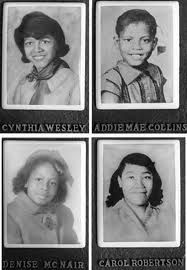
Fifty years ago today at about 10:22am, the 16th Street Baptist Church in Birmingham, Alabama was bombed by four active members of the Klu Klux Klan, an American terrorist organization. Their names were Robert "Dynamite Bob" Chambliss, Herman Cash, Thomas Blanton and Bobby Cherry. They belonged to a splinter group of the KKK of about a dozen members called The Cahaba Boys that met every Thursday night near the Cahaba river to drink beer and gripe about ridding the south of Catholics, Jews and black people.  Why did they create a splinter group? Because they didn't feel that the Klan was radical enough. This, at a time when the city of Birmingham was called Bombingham (by us, of course -- because it was happening to us) because since the mid 1940s, so many homes and churches in the African-American community were getting blown up on a regular basis with no federal government intervention whatsoever.  And of course, all of the bombings were officially unsolved cases.

Very few people know that Condoleezza Rice -- the first black woman to serve as the United States' national security adviser, as well as the first black woman to serve as U.S. Secretary of State (2005 - 2009) -- could very easily have been one of those little girls.

A native of Birmingham, Condi was an only child to a teacher and a Presbyterian minister, both of whom were well-educated in historically black colleges, staunchly middle class and Southern natives, having survived the Great Depression and some of the worst racism this country had to offer.  They both knew the importance of a formal education and constantly stressed this to their child.  Initially home schooled (are you surprised by that one?) Condi's mother went so far as to enroll her in the first grade when she was 3 years old.  She could read music before she could read.

Here's a picture of the future Secretary of State with her mother Angelena, at home in Birmingham, Alabama in the 1950s.

She was 8 years old when her playmate Denise McNair -- 11 years old at the time -- was killed in the bombing.  Denise attended preschool at Condi's father's church, where he was a pastor.  When Condi was 11, her family relocated to another city in Alabama and shortly thereafter, to Denver, Colorado and then finally to Palo Alto, California.  And the rest is history.

I wonder: If those southern white terrorists knew that bombing that church would have caused the passage of the Civil Rights Act of 1964, would they have done it anyway?


Here's a 1997 interview of filmmaker Spike Lee for 4 Little Girls -- his first feature length documentary.  Interestingly, it was an article he read in the New York Times Magazine in 1983 when he was a first year film student at NYU that prompted him to make this movie.  His thoughts about how the movie got made are also very telling.

Documentaries are so important.  These girls would be lost to history books if Mr. Lee hadn't made this one.

A few days ago, the Congressional Gold Medal was given to the families of the four girls -- the highest honor a civilian can receive.  Somehow all of that rings hollow, especially in light of the fact that Carolyn Bryant -- the woman who pointed out Emmett Till to her husband and brother-in-law from the backseat of a sedan  -- is still alive and well at 74 years of age and relaxing comfortably with her loving family in Greenville, Mississippi. She's an accessory to his murder. Why has she never been prosecuted? Why isn't she in jail?

As if on cue, Congressman John Boehner wept openly during that Congressional Gold Medal ceremony.  When they prosecute Carolyn Bryant and many others like her for their crimes against African-Americans during the civil rights movement, I'll believe the sincerity of his tears.

Sunday, January 06, 2013

Top Ten Reasons Why I Liked Django Unchained (Spoiler Alert!)


(Please note: This is the second trailer for Django Unchained. Enjoy!)

I don't think Spike Lee was wrong -- I want to honor my ancestors, too -- but I can't criticize a movie if I haven't seen it. And yet everyone has an opinion on Django Unchained.  I supposed that's understandable. It's been awhile since Roots had everyone glued to their televisions for a week. And then we wanted to talk about it. We wanted to find our roots.

As a nation, we are in dire need of a collective roundtable discussion about race. And for once, we really need to make it an honest one. Perhaps the success of this movie will trigger an avalanche of talks, documentaries, exhibits and yes, more films.  Nothing gets more movies made in Hollywood like a blockbuster. The more information, the better.  Anything to get the ball rolling.

I have way more than ten reasons as to why I liked Django Unchained.  These are the ones that floated to the surface initially.
  1. It's funny.  Needless to say, the most telling moments happen when white people stop laughing and black people can't stop cracking up. The white guy behind me was giggling quite freely until Django beat the brakes off of that white man with a bullwhip. 
  2. It's fiction. Of course, that won't stop people from treating it like a documentary. 
  3. It's about slavery in the United States -- something of which way too many Americans know very little. They certainly know even less about its atrocities.  And they seem to know less than nothing of the Black Holocaust.
  4.  It's got a black (ex)slave hero. The truth is, there were hundreds of thousands of Nat Turners, disrupting anything whenever they could. Where's that movie?
  5. It's got a black hero that's beating, whipping, maiming, shooting and killing a garden variety of insufferably racist, bigoted white people. I can't think of any black people that wouldn't want to see that. Repeatedly.
  6. It's got a loving, solid black marriage.  Yes, black people want to see that, too -- in any time period. Slaves fought desperately for their marriages -- and their children. It didn't start with the Huxtables.
  7. Believe it or not, the black hero's wife doesn't pass the paper bag test.  Shocking, right?
  8.  It's got a black hero that's focused on saving his black wife by any means necessary.  I don't know about you but I don't see very many leading men in filmdom going to the absolute limit for the love of a black woman.
  9. Maybe it's my recent forays into the Rhineland or the research that I'm doing about Germans in the (Antebellum) South but I loved the German references within the storyline. (Interestingly, my last name is German. More on that later.) And those filthy greedy Australians? That was just too perfect.
  10. It's got a beautiful ending: the black hero and his girl ride off into the sunset together. I remember seeing that and thinking, Why not? Why shouldn't they run off and be happy? At Harlem's Magic Johnson Theater, the audience stood up and cheered.'Nuff said.
Perhaps Dangerfield Newby is the "real" Django Unchained.  He tried to buy his wife Harriett and their 7 children out of slavery but when the agreed-upon price was abrubtly raised once he'd met it, he sought other means and joined John Brown's raiders at Harper's Ferry. And the rest, as they say, is history.