Showing posts with label the civil war. Show all posts

Tuesday, December 10, 2013

Oh, Kanye, Part 3: That Confederate Flag and You

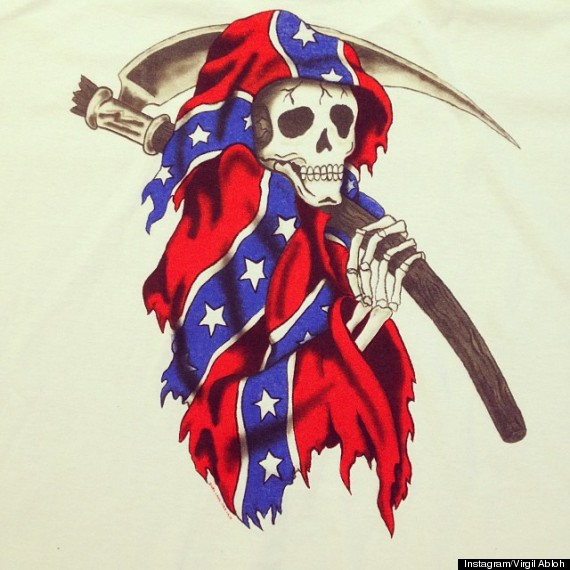
So these are the images in question by artist/illustrator Wes Lang


Nothing you haven't seen before, if you've even so much as glimpsed bands like Lynrd Skynrd, Metalica, Megadeth, The Grateful Dead, Judas Priest. Or if you know any bikers. Or purveyors of West Coast tattoo art. Kanye is appropriating that imagery and more, and draping a Confederate flag over it.

(Meh.)

I suppose Kanye KKK hoods and robes are next.  If he makes them fashionable enough -- and he can because that's a big part of what he does -- he won't have any trouble selling them. (Hey, that's got a ring to it - Kanye KKK!) He can wear one all the time and call himself The Grand Dragon Wizard -- of Greatness and Brilliance. Because, according to him, that's what he is.

Of course, later he will sell those KKK outfits -- and the regalia that accompanies them -- in Barneys in pastel hues for thousands of dollars. Because he's brilliant.  Right?

He sounds bipolar to me. Here's a few symptoms.
  1.  Feeling unusually “high” and optimistic OR extremely irritable 
  2. Unrealistic, grandiose beliefs about one’s abilities or powers 
  3. Hyperactivity 
  4. Racing thoughts; jumping quickly from one idea to the next 
  5. Impaired judgment and impulsiveness 
  6. Acting recklessly without thinking about the consequences 
  7. Talking so rapidly that others can’t keep up 
  8. Distractibility
    1.  
       
Manic depression is touching my soul
I know what I want but I just don't know
How to, go about gettin' it
Feeling sweet feeling,
Drops from my fingers, fingers
Manic depression is catchin' my soul

Woman so weary, the sweet cause in vain
You make love, you break love
It's all the same
When it's, when it's over, mama
Music, sweet music
I wish I could caress, caress, caress
Manic depression is a frustrating mess

Well, I think I'll go turn myself off,
And go on down
All the way down
Really ain't no use in me hanging around
In your kinda scene

Music, sweet music
I wish I could caress, caress, caress
Manic depression is a frustrating mess
                  Well, that just about sums it up for me. One thing is for sure. That flag isn't going anywhere.

                  Friday, December 06, 2013

                  Oh, Kanye Part 2: That Confederate Flag (in context!)

                  Now might be the moment to take a look at the Confederate flag in context -- something that most people aren't willing to do.

                  Everyone was flying a lot of flags in the South during The Civil War. (Please note: This war has a lot of names. Many Southerners refer to it as the War of Northern Aggression because according to them, it wasn't a war. It was an invasion. Most of their black counterparts called it The Freedom War. You get the idea.)   The Confederate flag as we know it (also known as "Stars and Bars") actually originated as the battle flag of the Army of Northern Virginia under General Lee.  There were three official Confederate flags to represent the new nation, none of which resembled the battle flag. To add to the confusion,  each Southern state created their own flag. All this flag waving was more than confusing, especially in battle. It was General PGT Beauregard who came up with the idea of a peace flag and a war flag, so enemies could easily be recognized in the fray.  He gave his assistant William Porcher Miles the task of creating the war flag. How he came up with it is more than interesting.

                  Inspired by the flags that he saw at the South Carolina secession convention in December of 1860, Miles -- who had been chair of the Committee on the Flag and Seal, conveniently enough -- came up with a blue St. George's Cross (also known as a Latin cross) on a red background, with white stars that represented each  slaveholding state. 


                  No surprise that he put the crescent and palmetto from South Carolina's state flag in the upper left corner.

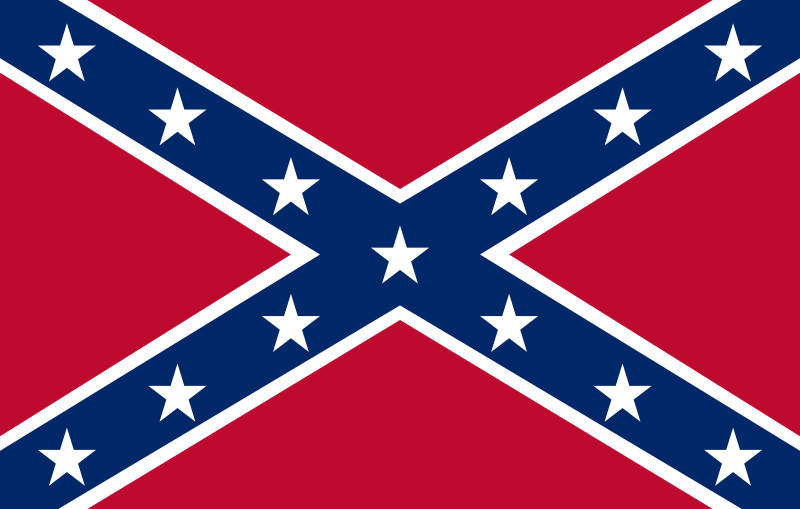
                  This flag, however, is the one that was chosen.


                  Miles changed it to a St. Andrews Cross (the cross of Scotland, interestingly enough) to appease Southern Jews who didn't want any religious symbol to represent the nation.  The number of stars changed according to how many states had joined The Cause.

                  Miles changed it to a St. Andrews Cross (the cross of Scotland, interestingly enough) to appease Southern Jews who didn't want any religious symbol to represent the nation.  The number of stars changed according to how many states had joined The Cause.

                  Needless to say, because the Southerners lost the war and remained rebels who were deeply committed to the idea that the war was an ongoing situation, the battle flag -- also known as The Dixie Flag, The Confederate Navy Jack, The Southern Cross and yes, The Rebel Flag -- was the one that they wholeheartedly embraced. 

                  As a Southerner by proxy -- that is, someone who is two generations removed from slavery -- I can't hold onto the Confederate flag in any way.  For the life of me, I don't understand exactly what Southerners have to be so proud of.  First of all, you lost. Yes, that's right. You lost the war. Yes, you fought valiantly. Yes, you have your brave war heroes, your majestic leaders. Even with all that greatness, you lost the war.  It doesn't matter how many times you dissect, review and reenact the battles. You still lost.

                  There, I said it.

                  Secondly, you fought for states rights -- that is, the right to have slaves -- which *surprise!* was completely immoral.  Thanks to the invention of the cotton gin in 1793, the growing abolitionist movement, Abraham Lincoln's election and a few other factors, the Southern antiquated social construct was eroding quickly. The end.

                  Last but not least, the antebellum South took their anger out on us -- wherein millions of black people were displaced, whole communities slaughtered, torture, violence and lynchings of black men, women and children was rampant and rape was commonplace. The state and local laws did nothing to defend or protect black people and the federal government did not intercede. Where is the pride in that? 

                  We are not a monolithic people. I no more expect young Southern black folk to take up the Confederate flag en masse than I would expect to see all young Jews running around wearing swastikas and waving SS flags, because they know their history.  That's what's missing in America --  a healthy dose of history and some real perspective.  A lot of old black folks lived through it and way too many black youth don't know about it.

                  You want a strong dose of Southern/American history? Read Buried In The Bitter Waters: The Hidden History of Racial Cleansing in America by Elliot Jaspin and then tell me if you seriously want to wrap yourself in a Confederate flag.

                  A description from Goodreads: Leave now, or die! From the heart of the Midwest to the Deep South, from the mountains of North Carolina to the Texas frontier, words like these have echoed through more than a century of American history. The call heralded not a tornado or a hurricane, but a very unnatural disaster--a manmade wave of racial cleansing that purged black populations from counties across the nation. We have long known about horrific episodes of lynching in the South, but the story of widespread racial cleansingabove and below the Mason-Dixon line--has remained almost entirely unknown. Time after time, in the period between Reconstruction and the 1920s, whites banded together to drive out the blacks in their midst. They burned and killed indiscriminately and drove thousands from their homes, sweeping entire counties clear of blacks to make them racially "pure." The expulsions were swift-in many cases, it took no more than twenty-four hours to eliminate an entire African-American population. Shockingly, these areas remain virtually all-white to this day. Based on nearly a decade of painstaking research in archives and census records, Buried in the Bitter Waters provides irrefutable evidence that racial cleansing occurred again and again on American soil, and fundamentally reshaped the geography of race. In this groundbreaking book, Pulitzer Prize-winning journalist Elliot Jaspin has rewritten American history as we know it.

                  Next up: Oh, Kanye Part 3:  That Confederate Flag and You

                  Wednesday, November 27, 2013

                  Oh, Kanye -- Part 1: That Confederate Flag

                   
                  In an interview with AMP Radio, Kanye West said, "The Confederate flag represented slavery in a way. That's my abstract take on what I know about it, right? So I wrote the song, 'New Slaves.' So I took the Confederate flag and made it my flag. It's my flag now. Now what you gonna do?"

                  Later in the same interview, he said, "It's colorless also. It's super-'hood and super-white-boy-approved at the same time."

                  When I heard about Kanye West's latest controversial explosion -- incorporating the Confederate flag into his tour merch designs as well as his personal life (wearing it as a patch on a green bomber jacket on a recent visit to Barney's) -- I thought it was a gag someone made up at The Onion.  Things are going so well with this latest flap that he's opened a pop-up store in Soho that sells these Confederate items.  While the irony of rednecks the world over lining Kanye's pockets by showing up at his concert and purchasing a t-shirt that bears the symbol of his ancestor's pain and oppression isn't entirely lost on me, there is much, much more to all of this that completely and utterly misses the mark. 

                  Of course, we expect these "outrageous" antics from Mr. West, and while many (but certainly not all) are standing in what appears to be a long, long line to congratulate him on his latest bit of controversy, let's be clear on one thing: Kanye West is hardly the first black rapper to embrace the Confederate flag.  Lil' Jon did this more than ten years ago -- and on the cover of his third album with The East Side Boyz, no less.


                  The picture is one of complete defiance. Look at that stance. There's nothing agreeable or subservient or compliant there. He is flanked by The East Side Boyz, their expressionless faces and white t-shirts further exaggerating Lil Jon's approach as well as the entire scenario.  As the flag drapes his shoulders like a cape, Lil Jon is almost daring the viewer to take that flag away from him.  Both of the flags in the background are on fire -- as if to counter the crosses that the KKK would burn "religiously" to intimidate black folk and other undesirables, he now burns their flag to intimidate them -- and he is on fire, too.  He is burning it down, as it were -- symbolically burning down the old South and what those traditions represent while holding onto what it means to him. Very nearly lit from within with a kind of makeshift rage that some would want to call urban propaganda, and with that gleaming trademark dental work run amok, he is the living embodiment of what some consider to be The New South. 

                  Kanye West, on the other hand, is from the Midwest (yes, he was born in Atlanta, GA but he left as a toddler, was raised in Chicago and is about to relocate to a Bel Air mansion). The flag may symbolize many things for him as an American and as an African-American but because it's not a part of his culture, he is far removed from it in a way that Lil Jon and The East Side Boyz are not. 

                  He is also extremely well off, quite famous and insulated from much of the reality of (Southern) black life, so its altogether likely that there's a quite a lot that he's probably not aware of. It should also be noted that Lil Jon and The East Side Boyz -- along with several other black Southern rappers like Outkast, Ludacris and David Banner -- have used the Confederate flag in the recent past. Kanye, on the other hand, is flat-out selling it.
                  What did Lil' Jon say when the press questioned him about draping himself with what many consider to be a symbol of racism and hate? "I'm from the South. That's what it represents to me.  We're Southern-born and raised. The flag is part of us. We look at it as just being proud to say we're from the South." 


                  In a review of the CD, Lil Jon elaborated thusly: "As a Southern group, we chose to bring the issue to the forefront in our album packaging. We're basically mocking racists on one hand by wearing The Confederate Flag, but at the same time we're repping the South. Do you know how infuriating it will be for a redneck to see me, a black deadlocked rapper, wearing The Confederate Flag around my shoulders? It's almost as bad as me dating his daughter. The Confederate Flag ain't going nowhere. It's part of Southern life and a reality of where we're from. Getting rid of the flag will not get rid of racism. Our album cover was our way of burning The Confederate Flag and all the racist mentality that comes with it; but we're also wearing it to show our love for The South." 

                  Lil Jon went on to say this: "The flag is a symbol and people attach their own meaning to it. To me The Confederate Flag is just that, a flag. We grew up seeing that flag everywhere. It's more offensive to the older Southern black folks who understand first-hand what the flag symbolizes, but I don't think younger folks view the flag in the same way."

                  Furthermore, Lil' Bo, one of the East Side Boyz, said: "Being born in the South, the flag has a different meaning for me than it would to people who aren't Southern. On one hand, I know a lot of lives were lost on both sides over it, but on the other it's a symbol of racial hatred that Black people in the South want to forget. It depends on which side of the line you're on."

                  Even if Lil Jon and The East Side Boyz did this as some sort of marketing ploy that would differentiate them from the rest of the Southern hip-hop herd and sell more albums, it makes the powerful statement that Kanye's flag-waving cannot because it's coming from young Southern black men.  For Lil Jon, waving this flag carries the weight and meaning and rebel intensity for which it was initially intended -- and in doing so, it is innately subversive.

                  In the next installment of Oh, Kanye -- Part 2: That Confederate Flag, we'll do the unthinkable and look at the flag in context.

                  Friday, June 07, 2013

                  30 Days of Birthday: Day 7 - The Civil War exhibits at The Met


                   An ambrotype image of the Pattillo Brothers of Henry County, each holding D-guard Bowie or side knives: (from l to r) Benjamin, George, James and John -- Company K, 22nd Regiment, Georgia Volunteer Infantry. They enlisted together on the same day -- August 31, 1861 -- and served with the Army of Northern Virginia.  If you'd like to know what happened to them in battle, click here.

                  When I spend the day at The Met in the Balcony Lounge -- listening to jazz, rewriting and rereading, and yes, thinking way too much -- sometimes I wander into an installation to distract myself and clear my head.  There are several on hand that coincide with the anniversary of the Civil War and they are wondrous.

                  The exhibit Photography and the American Civil War is the one that has consistently pulled me in from the inside out, in part because I love to tromp through history books and sift through it all to find out What Actually Happened.  This is the war that was photographed exhaustively, the first major conflict to come alive inside that lens. The hoi polloi was understandably transfixed.

                  What's especially alluring (and yes, disturbing) is that the people in the photos look real. Really, really real. There's just no other way to put it. Most of them look as though they are reaching through that expanse of space and time and whatever else stands between us, and really seeing me. The kicker is that a few of them look like people I actually know.  The brothers in the photo above are no exception.

                  I can't see a piece of art once and get everything out of it and walk away. The more I look at it, the more I see, the more inspired I feel.

                  These photos are ethereal.  I can't get them out of my head.

                  Sunday, May 05, 2013

                  Happy Cinco de Mayo, y'all...

                  While everyone gets trashed on margaritas and inhales copious amounts of Mexican food to celebrate -- what, Mexican Independence Day, right America? (wrong!) -- I thought it would be nice to have a two minute history lesson that explains it for those amongst us that might be curious as to What Actually Happened.


                  As much as I love the History channel's little blurb on this topic, this needs to be told from a black perspective -- like most of American history.  Because apparently, you won't know what really went down unless we tell it.

                  Here's the bottom line, plain and simple: If those French troops had provided much needed reinforcements to their Southern allies at that moment in the campaign, the Union might have lost The Civil War. And this country would be a very different place.

                  To dip into my archives for the golden oldie entry that goes into detail -- In Observance of Cinco de Mayo: A Lingering Afterthought -- please click here.

                  Oh -- and if you really want to crack up, watch this.


                  Saturday, January 19, 2013

                  Envisioning Emancipation

                  Apparently, this somewhat celebratory moment that commemorates the Emancipation Proclamation isn't lost on Hollywood or the media. There are an avalanche of movies, documentaries, exhibits and the like that are to be released within the next two years. Here's a little something that caught my eye. 

                  The book Envisioning Emancipation: Black Americans and The End of Slavery -- released on January 1st by Temple University Press -- has me spellbound. I get lost inside those faces, their collective stance, the feel of it all. They are somber, elegant and in most instances, they are painfully well dressed. What's especially disturbing is that they look too familiar. I remember thinking, I know that look on that little boy's face. The way that soldier's shoulder is thrown back, the way her arms are folded. If I look at those pictures for too long, I can almost sense their thoughts. It's all so dignified, so full of self-respect and hope.

                  Many of the photos have never been seen before. God only knows where they were hidden or how they were found. 


                  Images in media are so much more important than we think they are.  As we are shown someone else's perspective of us, we are taught so many things  -- who we are, what we look like, where we stand, whether we truly matter.  For God knows how long -- for too long, really -- we have seen ourselves through the bluest eye. And now this: thousands of photographs taken by us, for us -- black photographers capturing snapshots of black people as they stand on the brink of freedom and true self-determination. I have seen other pictures from this era and when I look at these, I can feel the difference.


                  Tuesday, May 10, 2005

                  In Observance of Cinco de Mayo: A Lingering Afterthought

                  While at a festive gathering somewhere in the bowels of this burgeoning metropolis to celebrate Cinco de Mayo a few years ago with a bunch of Dominicans and NuYoRicans, a redheaded Texan I knew rather wryly observed that most Latinos that she encountered in Yankeelandia didn’t know anything about our beloved Mexican holiday. As far as she could tell, it was just another reason to throw a party. As an honorary Texan, I had to concur.

                  When I lived in Texas, it was the event of the year. If I could, I would spend every Cinco de Mayo in San Antonio. What a beautiful little town. Sometimes my friends and I would go to there for the day, to make sure that we ripped it up just right. There were tequila tastings, lots of Tejano music and of course there was incredible Mexican food and Tex-Mex, the likes of which cannot be found up here—and trust me, I’ve looked. More importantly, we knew why the day was important and we were extremely proud of it, even though we weren’t Mexican at all. Where did that pride come from, you ask? The mezcal?

                  I’d taken enough required classes on Texas history as a student while at UT to know that it was essentially an unofficial Mexican/Mexican-American July 4th holiday. No one ever tells the real story: the Mexicans collectively beat an army that hadn’t been defeated in 50 years. Not just any army—the army of Emperor Napoleon III, nephew of Napoleon Bonaparte. And the Mexican general that led the fray was a Texan! Finally, Europe was officially out of Mexico and the Mexicans were free to rule themselves. (Now why do you suppose no one in Hollywood wants to make a movie about that?) It's a really good thing the Mexicans did this, kids. Remember, this happened in 1862. While both Mexico and the US were having civil wars, the French sided with the South. (In spite of popular opinion at the moment, the French have been buddies with the US for quite some time. They helped us gain our independence from England. Y'all know who General Lafayette is, don't you?) If the French had won in Mexico, they would have sent reinforcements through Texas to help the Confederates win the Civil War. And we probably wouldn't be having this conversation.

                  I don't care what anyone says. As a Southerner that’s only two generations removed from slavery, Cinco De Mayo is very much my holiday.

                  I think it's wonderful that everyone has their Independence Day because its a cool way to introduce yourself to another culture. Of course, African-Americans in Texas have been celebrating Juneteenth as their July 4th for quite some time—another very important day that isn’t really honored with much fanfare up here. Such holidays can be a great way to unify us. In understanding the history of Cinco de Mayo and celebrating the event, we can better understand ourselves and our collective history as Americans.

                  There’s a push to make Juneteenth a national holiday for African-Americans. If it happens, how lovely—and if it doesn’t happen, I suppose that’ll have to be lovely too. It’s certainly not going to stop my fish fry. Why should we wait around for the powers that be to “officially” recognize and validate what we know to be ours? Heck. Let’s all take the day off on Malcolm X’s birthday, not just Martin Luther King, Jr. And Zora Neale Hurston. And Robert F. Williams, too. Why not? Pick your hero and celebrate your heritage. Make the world wonder what in the world we’re up to—and for the love of Benji, fill them in.