Whilst traipsing through Black Tumblr, I found a phrase that encompassed much of what I've been experiencing all too often lately: white fragility. A conversation about race begins and everything is fine until I say something that makes the white person uncomfortable. (And believe me, it doesn't take much.) That's when they become defensive or go into attack mode or they shut down and walk off.
And yeah, it's virtually impossible to talk to white people about racism -- which is why white people who are woke should do the heavy lifting on this issue. It's more likely that other white people will listen to them.
The following are examples of the kinds of challenges that trigger racial stress for white people:
Suggesting that a white person’s viewpoint comes from a racialized frame of reference (challenge to objectivity);
People of color talking directly about their own racial perspectives (challenge to white taboos on talking openly about race);
People of color choosing not to protect the racial feelings of white
people in regards to race (challenge to white racial expectations and
need/entitlement to racial comfort);
People of color not being willing to tell their stories or answer
questions about their racial experiences (challenge to the expectation
that people of color will serve us);
A fellow white not providing agreement with one’s racial perspective (challenge to white solidarity);
Receiving feedback that one’s behavior had a racist impact (challenge to white racial innocence);
Suggesting that group membership is significant (challenge to individualism);
An acknowledgment that access is unequal between racial groups (challenge to meritocracy);
Being presented with a person of color in a position of leadership (challenge to white authority);
Being presented with information about other racial groups through,
for example, movies in which people of color drive the action but are
not in stereotypical roles, or multicultural education (challenge to
white centrality).
Not often encountering these challenges, we withdraw, defend,
cry, argue, minimize, ignore, and in other ways push back to regain our
racial position and equilibrium. I term that pushback white fragility.
"Here’s the thing. When we talk about race relations in America or racial
progress, it’s all nonsense. There are no race relations. White people
were crazy. Now they’re not as crazy. To say that black people have made
progress would be to say they deserve what happened to them before. So, to say Obama is progress is saying that he’s the first black person
that is qualified to be president. That’s not black progress. That’s
white progress. There’s been black people qualified to be president for
hundreds of years.
If you saw Tina Turner and Ike having a lovely
breakfast over there, would you say their relationship’s improved? Some
people would. But a smart person would go, “Oh, he stopped punching her
in the face.” It’s not up to her. Ike and Tina Turner’s relationship has
nothing to do with Tina Turner. Nothing. It just doesn’t. The question
is, you know, my kids are smart, educated, beautiful, polite children.
There have been smart, educated, beautiful, polite black children for
hundreds of years. The advantage that my children have is that my
children are encountering the nicest white people that America has ever
produced. Let’s hope America keeps producing nicer white people." (Read the rest of the New York interview here.)
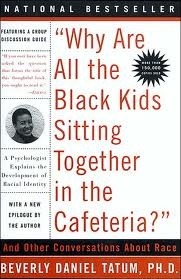
My summer reading list is full -- and yet, I'm squeezing this in, anyway. My response to this question was usually something like, "Where are we supposed to sit?" As it turns out, I was right.
From the Amazon.com review: Anyone who's been to a high school or college has noted how students of
the same race seem to stick together. Beverly Daniel Tatum has noticed
it too, and she doesn't think it's so bad. As she explains in this
provocative, though not-altogether-convincing book, these students are
in the process of establishing and affirming their racial identity. As
Tatum sees it, blacks must secure a racial identity free of negative
stereotypes. The challenge to whites, on which she expounds, is to give
up the privilege that their skin color affords and to work actively to
combat injustice in society.
yes, i'm one of those black people that forgot all about black history month -- probably because i'm black every month of the year and i'm all about my blackness every single day. black-black-blackity-black! i suppose if the world at large weren't constantly coming up with colorful and interesting ways to make me aware of the fact that yes, i'm a negress, my blackness probably wouldn't float to the surface of my conscious mind every other waking moment. oh, well.
i suppose i could post some especially black stuff in the next few weeks but don't i do that anyway? i'm starting to research my history as a black female performer, so here's a few things for you to revel in:
my beautiful black women pinterest page. gathering those images and video clips are just one way that i get inspiration, ideas and remind myself that, yep, we're stunning, too.
a snippet of this little doc -- valaida snow, jazz trumpet star. her story is a fascinating one. she was quite the showstopper.
take a glimpse at joyce bryant: the lost diva documentary. she was described as "the black marilyn monroe" -- but why was she forgotten?
i can't even begin to say how much i miss my daddy.
yes, that's right. i'm an african-american woman with parents who were married to each other for nearly 50 years. my daddy left this world last year at the age of 92. no man worked harder than he did to provide for his family. back in the day, he held seven union cards. seven! i don't know anyone with more than two. my mother still lives in the house that they raised us in - all five of us. a big house, in cascade heights, in the ATL. and she's still running their real estate business, singlehandedly.
it makes me sick to my stomach, the things that everything in the media continually feeds us about black men and black fathers. while it's horrible that this garbage gets ingested worldwide, what's especially disturbing is that we've started to believe it about ourselves. we can't even make movies or tv shows about decent hardworking black fathers. absolutely everyone thinks they're unicorns. no one believes they're real.
so let me set the record straight, on my end: i had a daddy, a granddaddy and a great-granddaddy -- all of them, hard-working, sober, responsible, dedicated, church-going family men. and i know i'm not the only black person out here who can say that. the glass is hardly half empty.
today would have been a day of fun for him. he would have been celebrated in church, with a special service for fathers, surrounded by people congratulating him and wishing him well. and then of course a nice big dinner , surrounded by family, and then his easy chair and phone calls from near and far all day long from everyone that knows him, and opening all kinds of gifts and yelling at the grandkids and telling everyone what to do. the remote would be in his hand like a scepter, and he'd wave it around for dramatic effect whenever he would punctuate anything he'd have to say. and he had plenty to say. about everything.
if i couldn't be there, i would have sent a huge bouquet of flowers and something permanent and cool, something that he could touch and say, my only daughter gave this to me for father's day, like a tie clip. if i were actually there, i'd make dinner and serve it to everyone dutifully -- and in the middle of the meal, daddy would turn to my mother and say, in a stage whisper, our only daughter is serving us dinner, in this really astonished overly dramatic can-you-believe-it voice. like it's this massively huge thing that's not really happening right in front of him but it is. like it's something i never did when i came home. it's not like it never happened at all, ever. me making dinner and serving it and cleaning up afterwards was practically my entire childhood. i suppose he expected me to stay in that kitchen, making his oxtails and rice, until marriage put me in someone else's. but that was not to be.
it feels like i'm going to grieve him for the rest of my life. who knows. i probably will.
i'm actually okay with it, if that's what happens. everyone handles these things differently. i really don't know how else to be. besides, i am told that such traumatic things can sometimes trigger massive creative explosions. it makes a lot of sense, that something truly beautiful could eventually come out of so much sorrow.
he was honest, sincere, and very smart - a gifted communicator, a college student, a young father and husband, and an officer in the black panther party. how cool that he could see the positive impact of his hard work in the community and how it was making a difference in the lives of so many people. but it was the twang in his voice that got me. he seemed so down to earth and folksy and accessible. even now, when i see film clips of him casually talking politics, he feels like someone i used to know.
fred was killed - actually what i should say is, murdered - in his apartment by the chicago police in conjunction with the fbi. it seems that j. edgar hoover - everyone's favorite crossdressing homosexual! - was willing to do anything to twart a black power movement, even if that meant assassinating all of its officers.
i think the black power movement was extremely dangerous to the status quo because it was so inclusive. all power to all people wasn't just a chant they threw up in the air at rallies. they meant it. such a radical shift would have destroyed everything that edgar held dear. everyone would have stopped obsessing about things like race and gender issues and they would have focused on what's really going on.
here's the documentary "the murder of fred hampton" in four parts. i know it's a little long, but trust me - it's well worth watching. and really, shouldn't we always make every effort to know our history?
i can't ever remember not going to church on new year's eve when i lived down south. even now as a southern stranger in a northern strange land, it feels more than just a little odd when i don't make my way home to pray through the new year, surrounded by loved ones. the church that i attend doesn't have a new year's eve service, probably because of its proximity to times square. i would go to black churches that i knew of in brooklyn or queens or even harlem but once i settled into the ghetto, my big brothers made it plain that i was never to leave the house on certain nights of the year -- and after awhile, what they insisted upon became one of my city rules to live by, because it made a lot of sense. new year's eve was definitely one of those nights.
i spent this new year's eve with my friend and Grandma the Clown at Big Apple Circus (sooooo fun!) but waking up on new year's day and hearing the news reports of how many people got murdered in the tri-state area the night before was sobering enough to fill me with even more "stay home on new year's eve" resolve than ever -- at least, while i'm up here. i don't care how clean and safe they say new york city is. i don't care if they do turn times square into disneyland. i don't care how low the murder and crime rates drop, or how comfortable they make this place. it's still new york city. praying through the new year was something i did when i went home.
i didn't know that this tradition had a name. it was simply something that our entire family had always done, ever since anyone could remember.
so imagine my surprise when my friend shows me an article in the New York Times about the history of this african-american time-honored tradition, and why it resonates so deeply for so many of us black folk this year. although he is white with southern roots on his father's side of his family, he grew up in new jersey and had never heard of anyone going to church and praying through new year's eve until i suggested it.
it's important to note that according to bartelby.com, the definition of watch night is "a religious service held on new year's eve" and that there are many churches in this country who have services on this night. in fact, it was john wesley, founder of the methodist church, who started watch night services in america. and he got it from the moravians -- a small christian sect from the czech republic (bohemia, actually) that held the very first watch night in germany, 1733. the idea was to pray that God watches over everyone's souls into the new year. however -- that long wait in 1862 by so many for word from abraham lincoln on the last day of the year to confirm that he had emancipated millions of slaves all over the country gave watch night an entirely different meaning, one that black folks have embraced ever since.
here's an exerpt from the article in the Times:
Though barely known to most white Americans, Watch Night as observed in black churches holds a place among the highest holy days, surpassed only by Easter and Christmas. Originally an 18th-century Methodist addition to the calendar — and still observed in many Christian denominations — its special significance in the black religious tradition was cemented by its link to the New Year's Eve of 1862, when free blacks and abolitionists gathered to pray that President Abraham Lincoln would carry out his promise to sign the Emancipation Proclamation on Jan. 1, 1863.
i can't even tell you how much happiness flooded my soul when i heard this song. all of a sudden, it was summertime and i was 7 years old again -- surrounded by aunts and uncles and a hoarde of cousins in charleston heights, south carolina. i remember everything: ripping and running and romping around in the countryside, eating lots of seafood and reading whatever i wanted all the time -- which was mostly encyclopedias and biographies, and of course kid-lit like the little house on the prairie series. i loved half-pint!
i suppose i could ask "how green was my valley" as i remember my little kidhood but the real question to explore is: how black was my world? i had my great-grandparents, my grandparents and my parents. get christi love! was on the tv. pam grier was at the drive in. and so was cicely tyson. and abbie lincoln. and blacula. don cornelious was on soul train. all of my aunts and uncles had naturals. everybody wore dashikis. the first time i ever saw my uncle jackie's then girlfriend/now wife aunt mattie, she had on a beautiful gele, and i thought she was glowingly lovely. lots of their friends were visiting africa and spending time there. and this song flooded the airwaves -- or at least, my uncle tyrone's 8 track stereo system.
no one had to tell me that black was beautiful.
i watch black music videos nowadays, i look at black pop stars and i wonder -- was it all a fad? was it fashion? or a dream that we collectively felt would never end?
i think there was a moment back in the day when we began to truly love ourselves and each other. it's not that the "n" word didn't exist -- it's just that everybody was so caught up in calling each other "brother" and "sister" that no one ever bothered to use it. (we were COGIC, too -- i'm pretty sure that had a lot to do with it.) we began to explore our history, we embraced our past and found our way back to africa as best we could.
and then the 80s happened.
the thing is, all of what i remember is still alive in all of us, right below the surface. i know this is true because when i walk down the street and i call someone sister or brother, they give it right back to me with so much feeling that sometimes, it aches. years ago, i fell back into the habit of saying it all the time -- especially to the africans. instantunity: the glow that is exchanged never goes away. it's just sitting there, waiting to come alive whenever any of us says it to each other again.
as the world prepares to hear barack obama give the most important speech of his political career, it's interesting to note that today marks the 45th anniversary of the iconic i have a dream speech, delivered by martin luther king, jr to well over 200,000 people at the lincoln memorial during the march on washington for jobs and freedom. no one seems to pay any attention to the fact that the speech was only 15 minutes long and the section that everyone quotes ad nauseum -- i have a dream, today! -- was improvised. actually, his advisors wanted him to leave that part out of the speech because he'd used it 30 times in the previous months and they were convinced that it was tired and that he needed something new. what they didn't understand was that with each delivery, he was refining the way he would express this idea. they stayed up all night writing a new section to replace it. when dr. king was up there and in the moment, he launched into it anyway, and the rest is history.
have you ever heard the entire speech? in a sound-bite friendly world, not very many people have, so i thought i'd post it in its entirety.
no one ever brings up the fact that in the last year or so of his life, dr. king was focused on poverty and the underclass of every race, and criss-crossed the country to create "a multiracial army of the poor." when he died, the poor people's campaign had already been assembled and he was in the midst of organizing a second march on washington to address economic injustice. he wanted congress to enact a poor people's bill of rights. dr. king called this "the second phase" of the civil rights struggle. the media predicted an insurrection. can you imagine?
i can't even begin to fathom what this country would be like if it fully addressed the class struggle and made a concerted effort to eradicate the american serf. the powers that be and the media elite have a difficult time acknowledging that such a person exists, in part because it's not in their best interest to do so. what's clear is that the race issue -- as real and insidious and as horrible as it is -- is used as a well-worn distraction to keep everyone's attention diverted away from the economic issues and what's really at stake politically. the i have a dream speech had such a unifying effect. for one bright, shining moment, we were america, united. and then they killed him.
i'm not so sure that the dream is coming full circle with obama's nomination, simply because of this historical and much heralded coincidence. there is a saying i live by: if you want to make your dreams come true, wake up. after watching the democratic national convention over the past few days, it's clear that many of us are wide awake and taking a stand, and that's a beautiful thing that gives me a lot of hope.
could obama unite us? the truth is, everybody talks a great game because they know the socially acceptable things to say, and they make every effort to be politically correct to avoid conflict and save face. everybody rehearses their political opinions before they leave the house. the bottom line is, what they do when they step into a booth to vote is another issue entirely -- if they make the effort and vote at all. remember: half the people in this country who are eligible to vote didn't bother to do so in the last election. that could very easily happen again.
there are others who definitely need a wake-up call about what's really going on politically, here and in the rest of the world. if mccain gets elected, they're going to get it.
in the face of media hype and bunkum surrounding the CNN special on the state of our nation, it's always a good idea to get an intelligent thought-provoking black response -- especially if that response is from a black american man regarding statistics of black american males.
i don't trust anything the media tells me -- about what's happening in the world, on my home turf and most definitely what's happening with me and my black community. it's simply not in their best interest to tell me the truth. and that goes double for the government.
yes, i missed the CNN special Black in America: Black Women and Family. what can i tell you?my day had still had me running around like a chicken with my head cut off by early evening. maybe subconsciously, i wanted to miss it because i didn't want to have something else to be pissed off about, right about now. they'll rerun it ad nauseum, i'm sure.
in the meantime, here's an interesting twist: they're going to dissect all of it online, with experts and anchors and viewers oh my! you can send in commentary, video, you name it. they really want feedback. here's hoping they get it.
all i could think was, so what's the goal here? is it redundant to talk to me about what its like to be black in this country? are we attempting to uplift the race with stats about how well we're really doing? are we attempting to initiate thought-provoking conversations about issues like race and class? or are we trying to let white people in on something that they may not be aware of? and isn't it usually a totally different conversation when there are no white people in the room?
like i said, i missed the special. and unlike a lot of black folk i know, i'm going to make a point of watching it. still and all, having an online special is interesting. and yes, i'm definitely going to miss that, too -- i have an audition. more on that later.
Soledad O’Brien Hosts One-Hour Online Special Featuring iReports and Interviews with Viewers, Experts
On Thursday, July 24, at 12 p.m. (ET), CNN anchor and special correspondent Soledad O’Brien will host a live, one-hour online special entitled Black in America: Your Reaction on CNN.com Live, the site’s live, multi-stream video news service. Focused on CNN’s highly anticipated Black in America documentaries, the online exclusive will examine viewer reactions to Black in America: The Black Woman & Family, which airs tonight, Wednesday, July 23, at 9 p.m. (ET/PT) on CNN/U.S. During the CNN.com Live one-hour special, O’Brien will interview several prominent figures in Black America, as well as the documentary series’ producers about their 18-month investigation. CNN.com Live’s Black in America: Your Reaction also will feature a brief preview of Black in America: The Black Man, airing on CNN/U.S. Thursday, July 24, at 9 p.m. (ET/PT).
O’Brien will interview author and activist Maryann Reid about the themes discussed in her latest book, Marry Your Baby Daddy; as well as co-authors of Love in Black and White – former U.S. Defense Secretary William Cohen and his wife, Janet Langhart Cohen, a public relations consultant and former journalist – about their inspiring story of overcoming obstacles in race and romance as an interracial couple in America.
During CNN.com Live’s Black in America: Your Reaction, O’Brien will speak with Bishop James W.E. Dixon, II of The Community of Faith Church at the King’s Dome in Houston – which this week is holding Black in America viewing parties and town halls – about his congregation’s reaction to the documentary. O’Brien likewise will showcase viewer reactions that were taped following other special pre-screenings of the Black in America series in Atlanta, Chicago, New York City and Washington, D.C.
O’Brien will present viewers’ and users’ firsthand accounts of the black experience and reactions to the documentary series submitted to iReport.com, CNN Worldwide’s first uncensored, unfiltered, unedited, user-generated community Web site. Online users may share their firsthand accounts of and reactions to Black in America through video, photo, or audio submissions to www.iReport.com/BlackinAmerica. Black in America, reported by O’Brien, examines often under-reported stories of the African-American experience, including fresh analysis from new voices about the real lives behind the stereotypes and statistics that frequently frame the national dialogue about Black America. Black in America: The Black Woman & Family airs on Wednesday, July 23 at 9 p.m. (ET/PT), and Black in America: The Black Man airs on Thursday, July 24 at 9 p.m. (ET/PT). Black in America was filmed in high definition and will air on CNN/U.S., CNN HD and CNN International. The series will be available on iTunes and on video on demand (VOD) 24 hours following the premiere. Viewers should check with their local cable providers for VOD availability.
CNN.com is the world’s No. 1 destination for online and wireless news, garnering the greatest audience share among current events and global news sites. Launched in 1995, CNN.com draws from the resources of CNN Worldwide and its many partners to provide consumers with the most enriching, immediate interaction with news anywhere, seamlessly combining articles, videos, images, interactive features and user-generated content. CNN.com’s news video offering – both live and on-demand – is unparalleled on the Web. CNN.com’s recent awards include an Edward R. Murrow award, a National Headliner award and two EPpy awards.
just in time for the 4th of july, there's some hot black mess in the media that's going to have fox news foaming at the mouth for weeks.
when i was a kid in the 70s, we sang the black national anthem whenever we had to sing the national anthem, say the pledge of alliegance or salute the flag. who taught it to me? who told me what it was? who told me why it was important? maybe a music teacher. or my father. i'm not sure. the truth is that everyone -- from my great-grandparents to my next door neighbors to the children i didn't play with -- treated the song with a reverence and an importance that let me know it mattered a great deal. like the sandbox in the backyard or the pound cake under that glass dome on the kitchen table or fish and grits for dinner on fridays, it was always there. here's the kicker: every black anyone in my little kid world knew this song and they knew it cold. they sang it from the heart, with feeling. and in a way, all of us knowing this song gave us a kind of solidarity and a unity that bloomed all the time.
feeling this togetherness as a child in the south amongst black folk gave me a glimpse into the jim crow years that my now 92 year old father lived through and how, in the moments when all we had was each other, we looked out for each other in so many unspoken ways that don't seem to happen anymore -- probably because white people aren't lynching us as much as they used to or hanging us at their town picnics. what's ironic is that we need that solidarity now more than ever. but i digress.
when i first saw a photo of a lynching (in Jet magazine in the 70s) what struck me the most was that the white people wanted to pose with the twisted hanging bloody bodies. they were laughing and pointing and having so much fun. and don't kid yourselves, yankees -- lynchings and cross burnings happened all over the country, not just the south. even nat king cole's upscale beverly hills neighbors burned crosses on his lawn.
any chance of a national apology to black people for all of this crap? probably not.
i don't know every negro in america but i can't think of any black people that don't know this song. don't believe me? ask an african-american you know to sing it. i don't think we should stop singing it until they acknowledge what happened during slavery and reconstruction and -- at the very least -- apologize for it. there has never been a collective reckoning amongst all americans, where we talk about these ugly racist things openly and deal with our feelings in a supportive way. like south africa, we need a truth and reconciliation commission of our own. everyone should know who emmett till is.
any chance that carolyn bryant, the woman responsible for emmett's murder, will ever see the inside of a prison cell? probably not.
on my last visit home, my adorable 4 year old nephew thomas stood proudly before the entire family after sunday dinner and sang the whole song -- with no help from anyone, not even his musician father. only four years old! where did he learn it? pre-k. then again, of course they're teaching little black children the black national anthem. they live in ATL -- a black mecca if there ever was one.
with thomas' happy little rendition (that left my friend reeling), i realized that singing the song nowadays was really an act of protest. with that in mind, i had to admit that i thought it took a lot of balls for rene marie to sing that song in denver the way that she did.
an act of treason to have a black national anthem, you say? get off of your jingoistic high horse and get real. clearly, america is a nation divided. i know way too many southerners who sing "dixie" (a song straight out of the minstrel tradition) as their national anthem and salute the confederate flag as they do so. the united sons and daughters of the confederacy have been doing this in federal/state/locally funded public settings ever since they lost the civil war and no one has ever batted an eyelash, much less called their actions treasonous. this is the same organization that recently decided to put up this massively huge confederate flag in the middle of a busy interstate in florida. nationally, no one has noticed -- certainly not fox news.
much, much more as this develops.
oh -- and happy july 4th, america! (...you know i already celebrated my independence day on juneteenth...)
Denver singer opts for black national anthem lyrics over 'Star-Spangled Banner'
Rene Marie's unexpected choice at a mayor's event where she was asked to sing the more traditional song has prompted a chorus of criticism.
By DeeDee Correll Los Angeles Times Staff Writer
July 4, 2008
DENVER — The jazz singer, invited to perform the national anthem before the Denver mayor's annual state of the city address, stood at the microphone and let loose her voice.
What came out were the lyrics of the song known as the black national anthem, set to the tune of "The Star-Spangled Banner."
"Lift ev'ry voice and sing, Till earth and heaven ring," belted out Rene Marie, as the expressions of city officials behind her grew puzzled.
It was, Marie later said of the unpaid gig, an artistic expression of her emotions about being a black American and a decision she made months ago to no longer sing the national anthem. But instead of telling that to the mayor's office beforehand, "I pulled a switcheroonie on them," Marie told the Denver Post.
Now elected officials and residents are joining a chorus of outrage: Gov. Bill Ritter Jr. called her actions disrespectful; Mayor John Hickenlooper accused her of deceiving the city for the purpose of a political statement.
"We all respect artistic license and support freedom of expression," he said. "But in a tradition-laden civic ceremony . . . making a personal substitution for the national anthem was not an option. We asked for 'The Star-Spangled Banner' and that's what we expected."
Even Sen. Barack Obama, campaigning for the presidency this week in Colorado, weighed in.
"We only have one national anthem," Obama told the Rocky Mountain News on Thursday. "And so, if she was asked to sing the national anthem, she should have sung that. 'Lift Ev'ry Voice and Sing' is a beautiful song, but we only have one national anthem."
On newspaper websites, comments have poured in by the hundreds, most of them critical of the popular local singer. Some have said her performance would harm Obama's presidential bid, a suggestion Marie dismissed as "a serious overestimation of my influence as an artist."
She did not return a call seeking comment, but on her website she defended her decision in a statement:
"I am an artist," she wrote. "If I wait until I am asked to express myself artistically, or if I must ask permission to do it, it would never get done. I knew that if I asked to do my version of the national anthem, the answer would be 'no.' "
Marie, 52, said that as a child raised in the segregated South, she sang both songs. But she grew to feel the sentiments of freedom expressed in the national anthem weren't a reality "for black folks living in a town with Jim Crow laws, where the flag often hung from buildings they could not enter," she wrote.
"Nobody but black folks found comfort in 'Lift Ev'ry Voice and Sing,' " penned by James Weldon Johnson and put to music by his brother, J. Rosamond Johnson, in about 1900 to commemorate President Lincoln's birthday. The hymn was sung at protest rallies during the civil rights struggles of the 1950s and '60s.
So Marie decided to meld the two anthems in what she describes as a love song to her country. She said she also rewrote the melodies to "America the Beautiful" and "My Country 'Tis of Thee," but kept the lyrics. She calls the three-part suite "Voice of My Beautiful Country."
Though she apologized to the mayor for any distress she caused him in her performance Tuesday, she stopped short of the public apology others are calling for. "As for offending others with my music, I cannot apologize for that. It goes with the risky territory of being an artist," she wrote.
Her chances of performing her art for the city again?
Probably not good, according to Hickenlooper, who said he wished he had interceded during Marie's performance.
"We will do whatever it takes to ensure that a situation like this never occurs again," he said, "even if I have to sing the national anthem myself."
i don't understand how any thinking american can possibly believe that we live in a democracy, that the system in place is fair and just (if we have the same level of education and experience, shouldn't we all get paid equally?) or that white privilege and racial profiling don't exist. i don't think there's any way that we can fix the problems in this country if we aren't willing to acknowledge them.
i know plenty of black men that have had this happen to them. for the sake of the entire NYPD, they'd better hope and pray that it never happens to me.
'NY Post' Reporter's Racial Profiling Suit Counters 'Post' Editorial By Joe Strupp Published: May 07, 2008 3:32 PM ET NEW YORK
On the same day that a New York Post editorial claimed racial profiling was not a growing problem, one of the Post's own reporters filed suit against the city claiming to be a victim of such profiling. Leonardo Blair, 28, a Post staffer since May 2007, filed the lawsuit in U.S District Court in Manhattan, according to a copy provided by the New York Civil Liberties Union. The complaint claims Blair was subjected to racial profiling while walking from his car to his home in the Bronx on Nov. 28, 2007.
A Jamaican immigrant and graduate of the Graduate School of Journalism at Columbia University, Blair claims he was harassed by police while walking along the street with his then-fiancee. In the lawsuit, he alleges that Officer William Castillo, one of several defendants the reporter names, stopped him due to his dark skin color and without cause. "Officer Castillo angrily demanded of Mr. Blair whether he spoke English," the suit stated. "Mr. Blair, surprised by Officer Castillo's mocking tone, replied under his breath in Spanish that he did not."
Eventually, after being frisked, Blair was arrested, the complaint states. "Mr. Blair was not engaged in any illegal or improper activity, and nothing in his behavior or conduct would provide the basis for reasonable suspicion that he was engaging in any wrongdoing," the lawsuit contends. “Leo Blair was handcuffed and hauled to a precinct house for simply walking down the street,” said Donna Lieberman, NYCLU executive director. “Walking while black is not a crime, and yet every year hundreds of thousands of innocent New Yorkers are stopped, searched and interrogated by the police for doing just that. For justice in our city to be truly just, the NYPD needs to start treating all New Yorkers fairly, regardless of the color of their skin.”
Blair said in a statement: “The only reason why I declared to these officers that I was a reporter for the New York Post, that I was a graduate of Columbia University, is because I wanted it to end. I should not have to pull on cards to be respected as an individual.” Blair was issued two summonses, one alleging he disobeyed a lawful order and the other alleging he made “unreasonable noise.” A judge dismissed both summonses on Feb. 8, NYCLU stated. The NYCLU, in a statement, said it "is asking the court to issue a declaratory judgment that the defendants violated Blair’s constitutional rights under the Fourth and Fourteenth Amendments. It also is asking that all records of Blair’s arrest, including those entered in the NYPD’s massive stop-and-frisk database, be sealed or expunged."
A New York Police Department Public Affairs spokesperson said the department does not comment on lawsuits. Ironically, the lawsuit was filed the same day that the Post editorialized in defense of police who have come under fire for alleged racial profiling. The issue was recently raised again after statistics released earlier this week revealed that New York City police stopped more people on the streets during the first three months of 2008 than during any quarter in the six years the police department has reported such data.
"Police overreach? Well, consider this: Last week, a killer said to be wearing a 'Team Fresh' gang T-shirt fatally stabbed an 18-year-old who was standing his own front porch. Isn't it a pity that the killer didn't encounter a stop-and-frisk team on his way to the scene of the crime?" the Post editorial said, in part. "Taken another way: How many young men didn't fall victim to weapons confiscated by the teams? A lot, we'd guess. If cops stand down, as critics demand, it'll be welcome back crime and chaos. And good-bye, peaceful New York."
Editor Col Allan and Editorial Page Editor Bob McManus did not immediately return calls from E&P seeking comment. Joe Strupp (jstrupp@editorandpublisher.com) is a senior editor at E&P.